
Contents
Overview
The distinction between accuracy and precision has roots stretching back to the earliest systematic attempts at measurement, though formalization is a more recent endeavor. Ancient astronomers and surveyors grappled with the inherent variability in their tools and methods, implicitly understanding that some measurements were closer to the 'real' celestial positions or land boundaries than others, and that repeated observations often yielded slightly different results. The scientific revolution, particularly with figures like Isaac Newton and his laws of motion, demanded increasingly rigorous measurement, pushing the need for clear definitions. By the late 19th and early 20th centuries, with the rise of statistical mechanics and experimental physics, mathematicians and scientists like William Sealy Gossset (creator of Student's t-distribution) and Ronald Fisher began to develop statistical frameworks to quantify and account for measurement errors, laying the groundwork for modern definitions of accuracy and precision as distinct statistical properties.
⚙️ How It Works
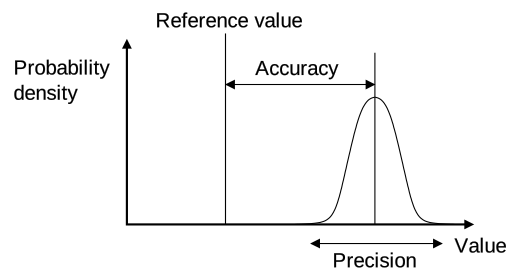
At its core, accuracy refers to how close a measurement is to the true or accepted value, addressing systematic errors or bias. Precision, on the other hand, describes the reproducibility of measurements, indicating how close repeated measurements are to each other and reflecting random errors. Imagine a dart player: an accurate player consistently hits the bullseye. A precise player throws darts that land very close to each other, but not necessarily near the bullseye. A measurement can be precise but inaccurate (all darts clustered far from the bullseye), accurate but imprecise (darts scattered widely but centered around the bullseye), both accurate and precise (darts clustered tightly around the bullseye), or neither accurate nor precise (darts scattered widely and off-center). The International Organization for Standardization (ISO) defines 'trueness' as the closeness of the mean of a large number of measurements to the true value, which aligns with the common scientific understanding of accuracy.
📊 Key Facts & Numbers
Precision is directly related to the magnitude of random errors, often expressed as standard deviation or mean squared error. In particle physics experiments at the CERN Large Hadron Collider, detectors aim for both high accuracy in reconstructing particle trajectories and high precision in measuring their momenta, with uncertainties often quoted in the range of a few percent or less for key measurements.
👥 Key People & Organizations
While the concepts of accuracy and precision are fundamental, their formalization and rigorous application are often attributed to statisticians and metrologists. William Sealy Gossset developed statistical methods crucial for understanding variability and error in the early 20th century, influencing fields like quality control at Guinness Brewery. Ronald Fisher refined experimental design and analysis, emphasizing the importance of minimizing bias and random error. Organizations like the National Institute of Standards and Technology (NIST) in the United States and the Bureau International des Poids et Mesures (BIPM) globally are instrumental in establishing standards and disseminating best practices for accurate and precise measurement across scientific and industrial domains.
🌍 Cultural Impact & Influence
The distinction between accuracy and precision permeates countless aspects of modern life, often implicitly. In medical diagnostics, an accurate test correctly identifies disease presence or absence, while a precise test yields consistent results upon repeated testing. A doctor relies on both to make sound diagnoses. In manufacturing, precise machinery can produce identical parts repeatedly, but if the calibration is off (inaccurate), all those identical parts might be defective. The widespread adoption of quality management systems like ISO 9001 underscores the societal value placed on both accuracy and precision in product development and production. Even in everyday estimations, like judging distances or quantities, our success depends on our ability to be both 'on target' (accurate) and consistent in our judgment (precise).
⚡ Current State & Latest Developments
The ongoing drive for higher fidelity in scientific instruments and data analysis continues to push the boundaries of accuracy and precision. In fields like astrophysics, the James Webb Space Telescope (JWST) is designed to achieve unprecedented levels of accuracy and precision in capturing light from the early universe, enabling scientists to refine cosmological models. Similarly, in biotechnology, advancements in gene sequencing technologies, such as those developed by Illumina, aim for higher throughput with greater accuracy in base calling. Flawed data can lead to biased or unreliable AI models, a challenge actively being addressed by researchers at Google AI and Meta AI.
🤔 Controversies & Debates
A persistent debate revolves around the precise definition and application of 'accuracy' itself. While the ISO definition of 'trueness' is widely accepted in metrology, some fields, particularly in social sciences or less quantitative disciplines, may use 'accuracy' more loosely to encompass both closeness to the true value and reproducibility. This can lead to confusion. For example, in psychological testing, a test might be precise (yielding consistent scores) but not accurate (not truly measuring the intended psychological construct). The challenge lies in ensuring that when 'accuracy' is invoked, its specific meaning—whether bias-free measurement or a combination of bias and variance—is clearly understood within the context of the discipline or study. The controversy spectrum for accuracy and precision is relatively low (around 20/100) in hard sciences but can rise significantly in interdisciplinary applications.
🔮 Future Outlook & Predictions
The future will likely see even more sophisticated methods for error quantification and correction, pushing the limits of what is measurable. Quantum sensing technologies, for instance, promise to achieve levels of precision and accuracy orders of magnitude beyond current classical methods, potentially revolutionizing fields from geophysics to medical imaging. As datasets grow exponentially, the development of advanced statistical techniques and AI-driven error detection will become crucial for maintaining data integrity. Furthermore, the increasing complexity of systems, from autonomous vehicles to advanced robotics, will demand ever-higher standards of accuracy and precision in their sensor inputs and control systems, with companies like Tesla investing heavily in sensor fusion and calibration to achieve this.
💡 Practical Applications
Accuracy and precision are critical in virtually every field involving measurement. In engineering, they ensure the reliability and safety of structures and devices, from bridges designed by ARUP to microchips manufactured by TSMC. In finance
Key Facts
- Category
- science
- Type
- topic