
Contents
- 🔭 What is Astronomy in Art?
- ✨ The Cosmic Connection: Why Artists Look Up
- 🌌 Historical Constellations: From Cave Walls to Cathedrals
- 🎨 Renaissance to Romanticism: Mapping the Heavens
- 🌠 Modern & Contemporary: The Universe as Muse
- 🌟 Key Figures & Masterpieces
- 🪐 Where to Experience Celestial Art
- 💡 Practical Tips for Your Cosmic Art Journey
- Frequently Asked Questions
- Related Topics
Overview
Astronomy has profoundly influenced art across centuries, from ancient cave paintings depicting celestial bodies to contemporary installations that challenge our perception of the universe. Artists like Vincent van Gogh, with his iconic 'Starry Night,' and contemporary figures such as Olafur Eliasson, who uses light and space to evoke cosmic themes, illustrate this enduring connection. The tension between scientific understanding and artistic interpretation fuels debates about the role of art in conveying astronomical concepts. As technology advances, the fusion of astronomy and art continues to evolve, inviting new interpretations and experiences of the cosmos.
🔭 What is Astronomy in Art?
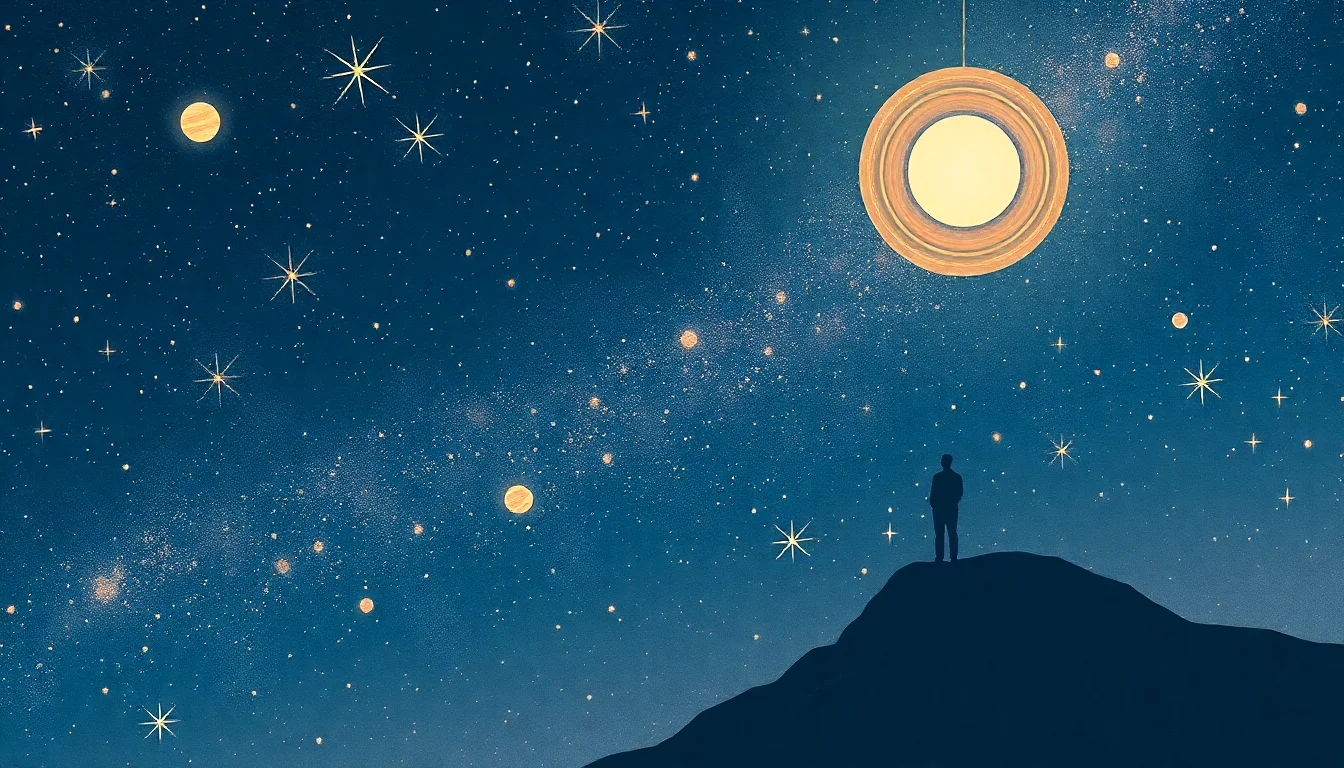
Astronomy in Art isn't just about pretty pictures of stars; it's a deep dive into humanity's enduring fascination with the cosmos, translated through visual mediums. This genre encompasses everything from ancient petroglyphs depicting celestial events to cutting-edge digital installations exploring exoplanets. It's for anyone who's ever gazed at the night sky and felt a sense of wonder, or who appreciates how art can illuminate scientific discovery and philosophical inquiry. Think of it as a celestial canvas where human creativity meets the infinite expanse of space, offering a unique lens through which to understand our place in the universe.
✨ The Cosmic Connection: Why Artists Look Up
The impulse to depict the heavens is as old as art itself. Early humans observed the predictable cycles of the sun, moon, and stars, integrating these cosmic rhythms into their understanding of the world and their place within it. These observations weren't merely scientific; they were deeply spiritual and mythological, influencing rituals, calendars, and storytelling. Artists, as chroniclers of human experience, naturally translated these profound connections into visual forms, making astronomy a foundational element in the earliest artistic expressions, a theme that continues to resonate through art history.
🌌 Historical Constellations: From Cave Walls to Cathedrals
The earliest evidence of astronomy in art can be found in prehistoric cave paintings and megalithic structures. Sites like Lascaux in France, with its depictions of bulls and horses, are theorized by some scholars to contain astronomical alignments. The Nebra sky disk, a Bronze Age artifact from Germany dating to around 1600 BCE, is one of the most significant archaeological finds, widely interpreted as an astronomical instrument or map. These early works demonstrate a sophisticated understanding of celestial phenomena and their importance in ancient societies, laying the groundwork for future artistic interpretations of the cosmos.
🎨 Renaissance to Romanticism: Mapping the Heavens
The Renaissance and Baroque periods saw a surge in astronomical art, fueled by the Scientific Revolution. Artists like Galileo Galilei, though primarily a scientist, had a profound impact on how the cosmos was perceived, and his telescopic discoveries were often depicted. The meticulous detail in Baroque paintings frequently included celestial motifs, reflecting a growing interest in accurate astronomical representation. Later, the Romantic movement embraced the sublime and awe-inspiring aspects of the night sky, with artists like Caspar David Friedrich capturing the emotional power of vast, starry landscapes, emphasizing the individual's connection to the infinite.
🌠 Modern & Contemporary: The Universe as Muse
In the modern and contemporary eras, astronomy in art has exploded in diversity and conceptual depth. From the abstract explorations of Joan Miró inspired by constellations to the photorealistic depictions of nebulae by artists working with astronomical imagery, the universe remains a potent muse. Digital art, virtual reality, and even AI-generated imagery are now pushing the boundaries, allowing artists to visualize phenomena beyond human perception, such as black holes or distant galaxies, and to explore themes of space exploration and humanity's future among the stars, often engaging with science communication.
🌟 Key Figures & Masterpieces
Several artists stand out for their significant contributions to astronomy in art. Vincent van Gogh's iconic 'The Starry Night' (1889) is perhaps the most famous, capturing a swirling, emotional vision of the night sky. In contemporary art, Olafur Eliasson's immersive installations often play with light and perception to mimic celestial phenomena, while Ansel Adams' breathtaking landscape photography frequently features dramatic skies. The Hubble Space Telescope itself has become an unlikely art producer, with its stunning images of nebulae and galaxies widely disseminated and influencing countless artists, blurring the lines between scientific data and aesthetic experience.
🪐 Where to Experience Celestial Art
Experiencing astronomy in art can take many forms. Major art museums like the Louvre in Paris or the Metropolitan Museum of Art in New York often house historical works with celestial themes. Science museums and planetariums, such as the Griffith Observatory in Los Angeles, frequently feature art installations or exhibits that bridge the gap between science and art. Contemporary art galleries worldwide showcase artists exploring cosmic themes, and online platforms offer a vast digital repository of celestial art, accessible from anywhere, allowing for a truly global appreciation of the cosmic aesthetic.
💡 Practical Tips for Your Cosmic Art Journey
When exploring astronomy in art, consider visiting a planetarium for an immersive sky show that can inspire your artistic interpretation. Look for exhibitions that specifically pair scientific imagery with artistic responses. Don't be afraid to explore less conventional spaces; astronomical themes can appear in street art, digital media, and even performance art. Engage with the scientific context behind the art – understanding the astronomical principles can deepen your appreciation for the artist's vision. Finally, consider creating your own celestial art; the universe is an endless source of inspiration for creative expression.
Key Facts
- Year
- 2023
- Origin
- Global
- Category
- Art & Culture
- Type
- Cultural Phenomenon
Frequently Asked Questions
What is the oldest known depiction of celestial bodies in art?
While interpretations vary, the Nebra sky disk from Bronze Age Germany (c. 1600 BCE) is one of the earliest and most compelling artifacts interpreted as an astronomical map. Earlier cave paintings, such as those found in Lascaux, are also theorized by some researchers to contain celestial alignments or depictions, though their interpretation remains debated among archaeologists and art historians.
How did the invention of the telescope impact art?
The invention of the telescope in the early 17th century, most famously by Galileo Galilei, revolutionized our understanding of the cosmos and, consequently, its depiction in art. Artists gained access to new visual information about the moon's surface, the phases of Venus, and Jupiter's moons. This led to more accurate, albeit still stylized, astronomical representations in paintings and scientific illustrations, bridging the gap between empirical observation and artistic interpretation.
Are there specific art movements that heavily feature astronomy?
Yes, several art movements have been significantly influenced by astronomical themes. The Romantic movement embraced the sublime and awe-inspiring aspects of the night sky. Later, movements like Surrealism and Abstract Expressionism often drew inspiration from the mysterious and boundless nature of the universe. Contemporary art continues to explore these themes through various media, often in dialogue with scientific advancements.
Where can I find contemporary artists working with astronomical themes?
Contemporary artists exploring astronomy can be found in galleries worldwide and through online art platforms. Look for artists who engage with themes of space exploration, cosmology, or the sublime. Institutions like Ars Electronica in Linz, Austria, often showcase cutting-edge digital and media art that intersects with science, including astronomy. Following major science publications and art journals can also lead you to emerging talents.
How does astronomy in art relate to mythology and religion?
Historically, astronomy and mythology/religion were deeply intertwined. Celestial bodies were often deified, and their movements were interpreted as divine will or omens. Many early artworks depicting stars, planets, and constellations are inseparable from their mythological or religious narratives, reflecting a worldview where the cosmos was a sacred text. This connection continues to be explored by artists who examine humanity's enduring search for meaning in the universe.
Can I visit places that specifically showcase astronomy in art?
While dedicated 'astronomy art' museums are rare, many institutions offer relevant experiences. Planetariums often incorporate artistic visualizations of space. Science museums may feature exhibits on the history of astronomical illustration. Major art museums house historical works with celestial motifs, and observatories sometimes host art exhibitions. The Griffith Observatory in Los Angeles is a prime example of a venue that blends astronomical observation with public engagement and artistic appreciation.