
Contents
Overview
Data warehousing solutions are sophisticated systems designed to consolidate, store, and manage vast amounts of data from disparate sources, transforming raw information into actionable business intelligence. These central repositories are crucial for reporting, analysis, and strategic decision-making, enabling organizations to uncover trends, optimize operations, and gain a competitive edge. By integrating historical and current data, often through processes like ETL (Extract, Transform, Load) or ELT (Extract, Load, Transform), data warehouses provide a unified, cleansed, and structured view of an enterprise's information assets. The evolution from early relational databases to modern cloud-based platforms like Snowflake and Google Cloud Platform's BigQuery signifies a dramatic shift in scalability, accessibility, and analytical power, fundamentally reshaping how businesses interact with their data.
🎵 Origins & History
The conceptual seeds of data warehousing were sown as businesses grappled with the growing volume of data generated by their operational systems. Early attempts to analyze this data often involved cumbersome manual processes and direct querying of transactional databases, leading to performance issues and inconsistent results. Precursors like IBM's DB2 and Oracle Database laid the groundwork for relational database management systems (RDBMS) that would become the foundation for early data warehouses. The development of Online Analytical Processing (OLAP) technologies further propelled the field, offering more sophisticated analytical capabilities beyond simple reporting.
⚙️ How It Works
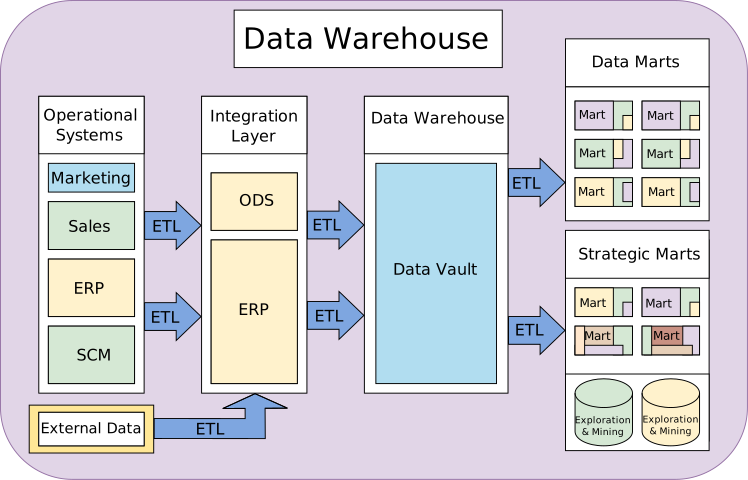
At its core, a data warehousing solution functions by extracting data from various source systems—such as CRM, ERP, financial applications, and even external data feeds. This data is then transformed to ensure consistency, cleanse errors, and conform to a predefined schema, a process often managed by ETL tools like Informatica or Microsoft SQL Server Integration Services (SSIS). Alternatively, ELT approaches load raw data directly into the warehouse and transform it there, a pattern popularized by cloud data warehouses. The integrated data is then loaded into the warehouse, typically structured using dimensional modeling techniques like star schemas or snowflake schemas, which optimize for query performance. This organized data is then accessible to business users and analysts through Business Intelligence (BI) tools such as Tableau, Power BI, or QlikView for reporting, dashboarding, and in-depth analysis.
📊 Key Facts & Numbers
Companies typically store petabytes of data, with some large enterprises managing exabytes. The cost of implementing a data warehouse can range from tens of thousands to millions of dollars, depending on scale, complexity, and chosen technologies. Cloud-based solutions have seen rapid adoption, with services like AWS's Redshift, Google Cloud Platform's BigQuery, and Microsoft Azure Synapse Analytics commanding significant market share. These platforms offer elasticity, allowing storage and compute to scale independently.
👥 Key People & Organizations
Key figures in the data warehousing landscape include Bill Inmon, often hailed as the 'father of data warehousing' for his foundational definitions and architectural principles. Ralph Kimball is another pivotal figure, known for his work on dimensional modeling and data warehouse lifecycle methodologies, which offer a more pragmatic, business-user-centric approach. Major technology vendors like IBM, Oracle, and Microsoft have long been dominant players with their on-premises solutions. In the modern era, companies like Snowflake, Databricks, and cloud providers such as AWS, Google, and Microsoft are leading the charge with cloud-native platforms. Independent software vendors (ISVs) like Informatica and Talend provide critical ETL/ELT tools that integrate with these warehouses.
🌍 Cultural Impact & Influence
Data warehousing has fundamentally reshaped organizational decision-making, moving businesses from intuition-based strategies to data-driven insights. It has enabled the rise of Business Intelligence (BI) as a critical business function, empowering departments from marketing and sales to finance and operations with performance metrics and trend analysis. The ability to consolidate customer data, for instance, has revolutionized customer relationship management (CRM) and personalized marketing campaigns. Furthermore, data warehouses underpin advanced analytics, machine learning, and artificial intelligence initiatives by providing the clean, structured data necessary for training models and generating predictions. The widespread adoption of data warehousing has also fostered a culture of data literacy within organizations, encouraging employees at all levels to engage with data.
⚡ Current State & Latest Developments
The current landscape is dominated by cloud-based data warehousing solutions, offering unparalleled scalability, flexibility, and cost-effectiveness. Platforms like Snowflake, AWS Redshift, Google Cloud Platform's BigQuery, and Microsoft Azure Synapse Analytics are continuously innovating, introducing features like real-time data ingestion, enhanced data governance, and integrated machine learning capabilities. The rise of the Data Lakehouse architecture, championed by companies like Databricks, aims to bridge the gap between data lakes and data warehouses, offering the flexibility of data lakes with the structure and performance of data warehouses. This convergence is driven by the need to handle diverse data types (structured, semi-structured, unstructured) within a single, unified platform, supporting both traditional BI and advanced AI workloads.
🤔 Controversies & Debates
One of the most persistent debates revolves around ETL versus ELT. While ETL offers robust data cleansing and transformation before loading, potentially ensuring higher data quality upfront, ELT leverages the massive processing power of modern cloud data warehouses to perform transformations after loading. This can be faster and more cost-effective for certain use cases, but requires careful management of data quality. Another controversy surrounds data governance and security; as data warehouses consolidate sensitive information, ensuring compliance with regulations like GDPR and CCPA becomes paramount, leading to ongoing discussions about access controls, encryption, and data lineage. The increasing reliance on third-party cloud providers also raises concerns about vendor lock-in and data sovereignty.
🔮 Future Outlook & Predictions
The future of data warehousing is inextricably linked to the broader trends in data management and analytics, particularly the rise of AI and machine learning. We can expect continued convergence towards the Data Lakehouse model, offering a unified platform for all data types and workloads. Real-time data processing and analytics will become standard, moving away from batch-oriented updates. Data governance and privacy will become even more critical, with AI-powered tools assisting in compliance and security. Furthermore, the democratization of data will accelerate, with more intuitive interfaces and low-code/no-code solutions enabling a wider range of users to access and analyze data. The integration of data warehousing with edge computing and IoT data streams will also become more prevalent, enabling analytics closer to the data source.
💡 Practical Applications
Data warehousing solutions are indispensable across virtually every industry. In retail, they power inventory management, customer segmentation, and personalized promotions. Financial institutions use them for fraud detection, risk assessment, and regulatory compliance. Healthcare organizations leverage data warehouses for patient outcome analysis, operational efficiency, and research. Manufacturing firms employ them for supply chain optimization, predictive maintenance, and quality control. E-commerce platforms rely on them for understanding customer behavior, optimizing product recommendations, and managing sales performance. Essentially, any organization that collects data and seeks to derive strategic value from it will find practical applications for data warehousing.
Key Facts
- Category
- technology
- Type
- topic