
Contents
Overview
The concept of the golden ratio, or divine proportion, traces its roots back to ancient Greece. While the precise mathematical formulation wasn't fully articulated until later, Euclid in his Elements (c. 300 BCE) described a method for dividing a line segment in the "extreme and mean ratio." Early mathematicians like Pythagoras and his followers were fascinated by numerical relationships, and it's plausible they explored such proportions. The term "golden ratio" itself, however, is much more recent, popularized in the 19th century by German mathematician Martin Ohm and later by Adolf Zeising, who extensively studied its supposed prevalence in nature and art, linking it to aesthetic ideals. Before Zeising, it was often referred to by terms like "divine proportion," a moniker attributed to Luca Pacioli in his 1509 book De divina proportione, illustrated by Leonardo da Vinci.
⚙️ How It Works
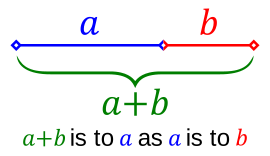
Mathematically, the golden ratio (φ) is defined by the equation (a+b)/a = a/b = φ, where 'a' is the larger quantity and 'b' is the smaller. This means the ratio of the sum of two quantities to the larger quantity is equal to the ratio of the larger quantity to the smaller quantity. Solving this equation yields φ ≈ 1.6180339887... It's an irrational number, meaning its decimal representation goes on infinitely without repeating. This ratio can also be derived from the Fibonacci sequence (0, 1, 1, 2, 3, 5, 8, 13, ...), where the ratio of consecutive numbers approaches φ as the numbers get larger (e.g., 13/8 = 1.625, 21/13 ≈ 1.615). Geometrically, a golden rectangle can be divided into a square and a smaller golden rectangle, a process that can be repeated infinitely, creating a spiral that approximates the golden spiral.
📊 Key Facts & Numbers
The golden ratio's value is approximately 1.6180339887. It is an irrational number, meaning its decimal expansion is infinite and non-repeating. The golden ratio is the solution to the quadratic equation x² - x - 1 = 0. The Fibonacci sequence (0, 1, 1, 2, 3, 5, 8, 13, 21, 34, 55, 89, 144...) provides approximations of the golden ratio; for instance, 144/89 is approximately 1.6179775. The golden ratio is also related to the Lucas numbers (2, 1, 3, 4, 7, 11, 18, 29, 47, 76, 123...), where the ratio of consecutive Lucas numbers also converges to φ. In terms of geometric construction, a golden rectangle has sides in the ratio of φ:1, and its area is approximately 2.618 times the area of the square formed by its shorter side.
👥 Key People & Organizations
While the golden ratio itself is a mathematical concept, its study and popularization involve several key figures. Euclid provided the earliest known formal description in his Elements. Luca Pacioli, a 15th-century Italian mathematician, popularized the term "divine proportion" in his treatise of the same name, which was illustrated by Leonardo da Vinci. The 19th-century German mathematician Adolf Zeising is credited with extensively researching and promoting the idea of the golden ratio's universal presence in nature and art, though his claims are now often viewed with skepticism. In modern times, mathematicians like Mario Livio have written extensively on the subject, exploring its history and scientific relevance, while artists and designers continue to reference it in their work, sometimes consciously, sometimes intuitively.
🌍 Cultural Impact & Influence
The golden ratio has exerted a profound influence on Western culture, particularly in the realms of art, architecture, and design. Artists and architects have long sought to incorporate its proportions, believing they create inherent beauty and harmony. Examples often cited include the Parthenon in Athens, the proportions of which are claimed by some to approximate golden rectangles, and the works of Leonardo da Vinci, such as the Mona Lisa and Vitruvian Man, where its presence is frequently debated. The golden ratio has also been linked to the human body, with some studies suggesting facial features and body proportions align with φ. Beyond visual arts, it has inspired musical compositions and continues to be a guiding principle in graphic design, web design, and product aesthetics, aiming for visually pleasing and balanced compositions.
⚡ Current State & Latest Developments
In contemporary design and digital interfaces, the golden ratio continues to be a relevant, albeit sometimes debated, tool. Designers at companies like Apple and Google may implicitly or explicitly use golden ratio proportions for layout grids, typography hierarchies, and image cropping to achieve aesthetically pleasing results. The concept is frequently discussed in online design communities and educational resources, serving as a benchmark for good design practice. While its application in nature is often scrutinized for overstatement, its utility in creating visually balanced and harmonious compositions remains a strong point for its continued use in fields like UI design and graphic design. The ongoing exploration of mathematical patterns in natural phenomena also keeps the golden ratio in scientific discourse.
🤔 Controversies & Debates
The pervasive claim that the golden ratio is ubiquitous in nature and art is a major point of contention. Critics, such as mathematician Keith Devlin, argue that many instances are coincidental, exaggerated, or based on selective measurement. For example, while some argue the Parthenon exhibits golden proportions, historical evidence for intentional application is scant, and measurements can be manipulated to fit the ratio. Similarly, claims about its presence in human anatomy are often based on approximations. The debate centers on whether the golden ratio is a fundamental principle of beauty and order, or if its perceived presence is a result of confirmation bias and the human tendency to find patterns, even where none objectively exist. The controversy spectrum for the golden ratio is high, with strong proponents and vocal skeptics.
🔮 Future Outlook & Predictions
The future of the golden ratio likely lies in its continued application as a design heuristic and a subject of ongoing scientific and philosophical inquiry. As computational tools become more sophisticated, algorithms may be developed to more precisely identify and apply golden ratio proportions in AI-generated art and design, potentially leading to new aesthetic frontiers. Researchers may also continue to investigate its role in biological systems, seeking more rigorous evidence beyond anecdotal observations. However, the debate over its inherent aesthetic value and its actual prevalence in nature will likely persist, ensuring the golden ratio remains a topic of fascination and discussion, challenging us to discern genuine mathematical harmony from perceived patterns.
💡 Practical Applications
The golden ratio finds practical application across numerous fields. In graphic design, it's used for creating layouts, logos, and typography that feel balanced and visually appealing. Architects employ it in building proportions, window placements, and overall structure to achieve aesthetically pleasing designs, as seen in some interpretations of Le Corbusier's Modulor system. Web design utilizes it for responsive layouts, content spacing, and image dimensions to enhance user experience. Artists may consciously use golden rectangles or spirals in their compositions to guide the viewer's eye. Even in finance, some traders use Fibonacci retracement levels, which are derived from the Fibonacci sequence and thus related to the golden ratio, to predict potential price movements in stock markets.
Key Facts
- Category
- aesthetics
- Type
- topic