
Contents
Overview
The concept of measuring north-south position on a sphere predates formal cartography. The Age of Exploration in the 15th and 16th centuries spurred immense practical demand for accurate latitude determination, leading to innovations in sextants and chronometers that improved longitude calculation, making the latitude-longitude grid a cornerstone of global navigation. The establishment of the Equator as the 0° parallel and the poles as 90° N/S became standardized through international agreements and scientific consensus.
⚙️ How It Works
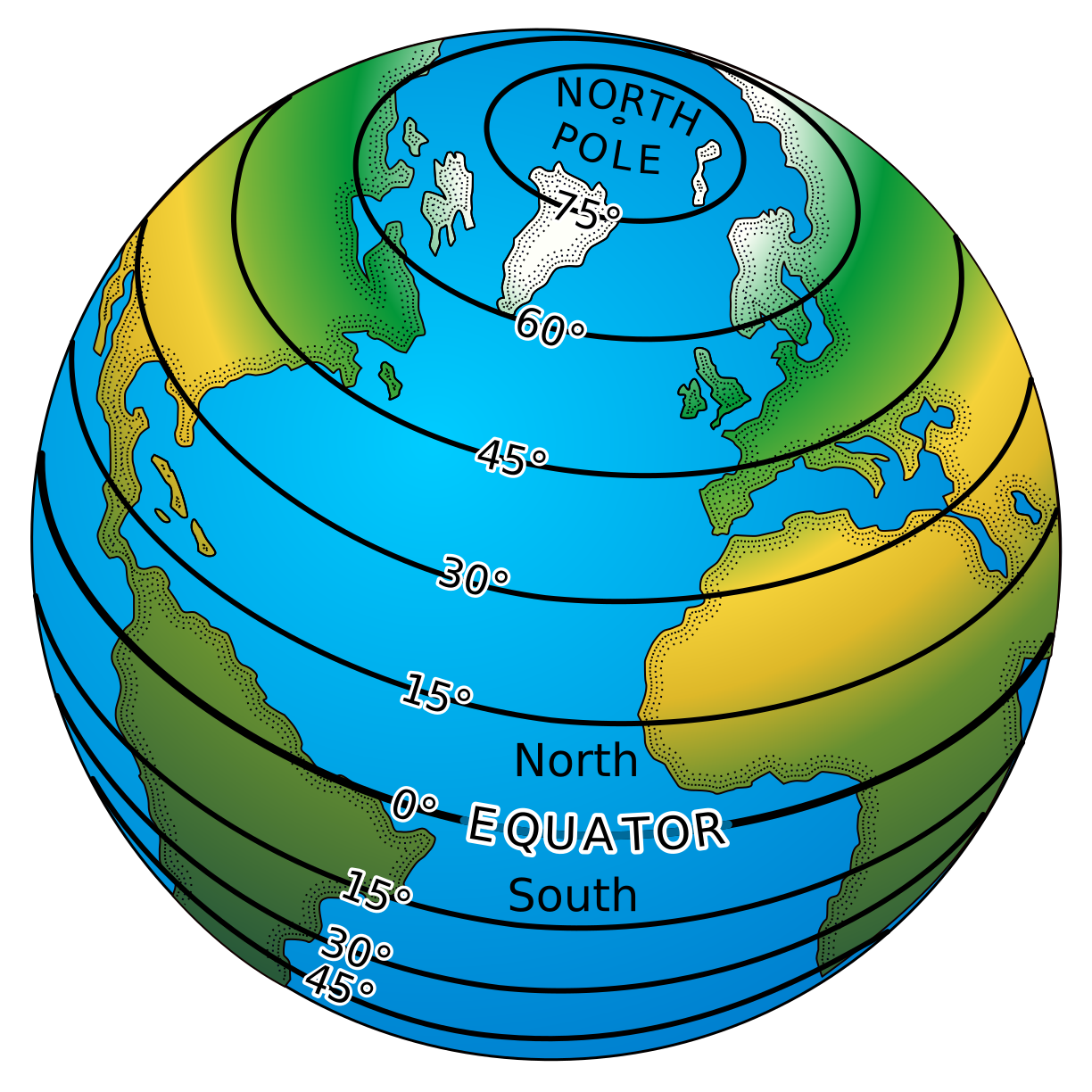
Latitude is fundamentally an angular measurement. On a spherical Earth, it represents the angle between a point's position vector and the plane of the Equator. Imagine standing at the Equator (0° latitude); your angle to the North Pole is 90°. At the North Pole itself, you are at 90° North latitude. The Earth is not a perfect sphere but an oblate spheroid, meaning its radius varies. Geodetic latitude, the most common type, is the angle between the equatorial plane and the line normal (perpendicular) to the Earth's surface at that point on the spheroid. Astronomical latitude, determined by observing celestial bodies like the Pole Star, measures the angle between the equatorial plane and the local horizon. Lines of constant latitude, called parallels, are circles parallel to the Equator, decreasing in circumference as they approach the poles. The Tropic of Cancer (23.5° N) and Tropic of Capricorn (23.5° S) mark the northernmost and southernmost latitudes where the sun can be directly overhead.
📊 Key Facts & Numbers
The Earth's circumference at the Equator is approximately 40,075 kilometers (24,901 miles), while the circumference of a parallel at 60° latitude is roughly half that, about 20,000 kilometers (12,400 miles). The maximum latitude value is 90°, representing the geographic poles. There are 180 degrees of latitude in total, from 90°S to 90°N. Each degree of latitude is approximately 111 kilometers (69 miles) apart, a distance that varies slightly due to the Earth's oblateness. The International Date Line, while primarily related to longitude, is also affected by the need to maintain consistent date changes across parallels. Over 70% of the Earth's surface is covered by oceans, with latitude playing a critical role in mapping these vast expanses for maritime navigation and understanding ocean currents. The Kármán line, often considered the boundary of space at 100 km altitude, is a horizontal plane, not directly tied to latitude but its definition is based on Earth's surface.
👥 Key People & Organizations
While no single individual 'invented' latitude, Hipparchus is credited with one of the earliest systematic uses of latitude and longitude in cartography. Ptolemy's comprehensive cataloging in Geography solidified its importance for centuries. During the Age of Discovery, navigators like Ferdinand Magellan and Christopher Columbus relied heavily on latitude calculations, though longitude remained a vexing problem until the invention of the chronometer by John Harrison in the 18th century. Modern geodetic surveying and satellite-based GPS systems, developed by organizations like the U.S. Department of Defense, provide unprecedented accuracy in determining latitude and longitude. The International Union of Geodesy and Geophysics (IUGG) continues to refine Earth's geodetic models, impacting precise latitude definitions.
🌍 Cultural Impact & Influence
Latitude profoundly shapes global climate patterns, defining tropical, temperate, and polar zones. The angle of solar insolation, directly dictated by latitude, determines temperature ranges and influences vegetation and biodiversity. Historically, latitude was a primary determinant of trade routes; sailing ships followed prevailing winds and currents, often dictated by latitudinal bands. The concept of 'latitude' itself has entered common parlance, sometimes used metaphorically to describe freedom or scope, as in 'giving someone latitude.' In literature and film, specific latitudes often evoke distinct settings, from the exoticism of equatorial regions to the harshness of polar extremes. The mapping of latitude has been integral to territorial claims and geopolitical boundaries throughout history, as seen in colonial-era treaties and modern border disputes. Understanding latitude is also key to comprehending phenomena like the Aurora Borealis, which are most visible at high latitudes.
⚡ Current State & Latest Developments
In 2024, latitude remains a cornerstone of global positioning and mapping, primarily through GPS and other satellite constellations like Galileo and GLONASS. The increasing precision of these systems, often achieving sub-meter accuracy, allows for applications ranging from autonomous vehicles to precision agriculture. Geodetic datums are continually updated to reflect a more accurate model of the Earth's shape, refining latitude calculations. Research into Earth-observation satellites continues to leverage latitude data for monitoring climate change, tracking deforestation, and managing natural resources on a global scale. The development of augmented reality applications also increasingly relies on precise real-time latitude and longitude data to overlay digital information onto the physical world. The ongoing expansion of 5G networks and IoT devices further integrates location data, making latitude more pervasive than ever.
🤔 Controversies & Debates
One persistent, though largely resolved, 'controversy' in defining latitude historically revolved around the Earth's true shape. Early calculations assumed a perfect sphere, leading to inaccuracies, especially at higher latitudes. The development of the geodetic model of an oblate spheroid, championed by scientists like Alexis Clairaut, provided a more accurate framework. Another debate, more practical than theoretical, concerns the precision required for different applications. While casual navigation might use degrees and minutes, scientific research or military operations demand precision down to fractions of an arc-second, leading to ongoing refinements in measurement techniques and datums. The choice of geodetic datum (e.g., WGS 84) can lead to minor discrepancies in reported latitude between different systems, a point of contention in highly sensitive applications. Furthermore, the philosophical implications of defining a 'fixed' location on a dynamic planet, though not a scientific controversy, touches on how we conceptualize space and place.
🔮 Future Outlook & Predictions
The future of latitude measurement will likely be dominated by even greater precision and integration. Advancements in quantum sensing could offer new methods for determining position with unprecedented accuracy, potentially surpassing current GPS capabilities. The proliferation of IoT devices will embed latitude data into an ever-wider array of objects and environments, creating dynamic, real-time location intelligence. We may see the development of 'dynamic datums' that account for subtle, ongoing shifts in Earth's crust and mass distribution. Furthermore, as humanity expands its presence beyond Earth, the principles of latitude will be adapted for mapping other celestial bodies, requiring new reference points and coordinate systems. The integration of latitude data with other sensor inputs, such as altitude and orientation, will e
Key Facts
- Category
- science
- Type
- topic