
Contents
Overview
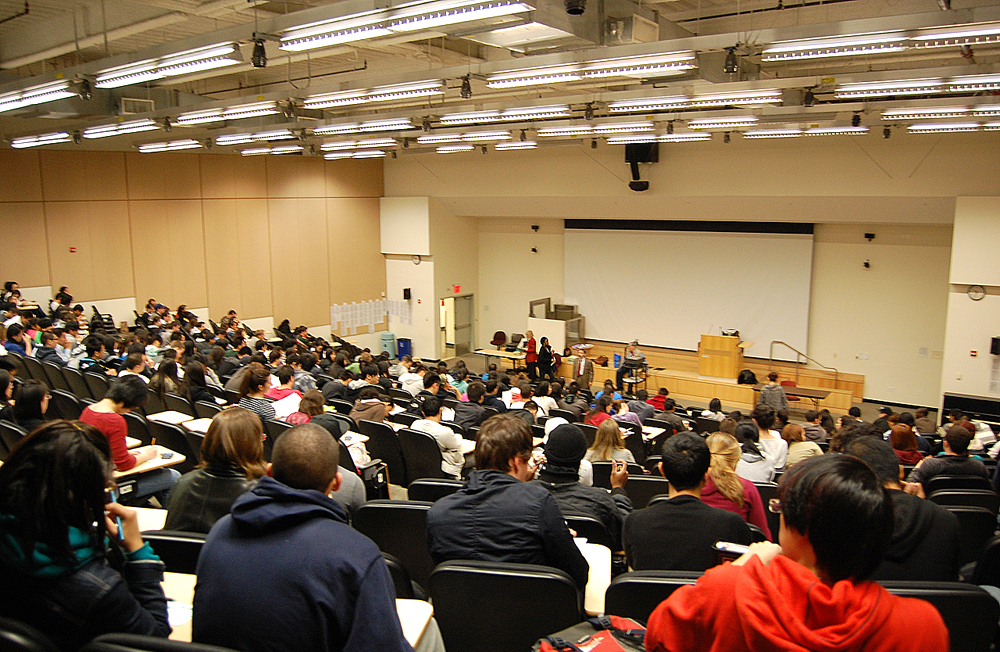
A lecture hall, often termed a lecture theatre, is a purpose-built space designed for delivering instruction to a large audience, typically found within academic institutions like universities and colleges. Characterized by tiered seating that elevates rear rows for optimal sightlines, these venues prioritize the singular focus of a presenter or audio-visual display over interactive pedagogy. Their fixed design limits flexibility for collaborative learning or experimental activities, distinguishing them from smaller classrooms and seminar rooms. Modern lecture halls are equipped with sophisticated audio-visual technology, including microphones and loudspeakers, to ensure clear communication across the expansive space. Their architectural design often reflects the prestige and gravitas of the institution, serving as iconic landmarks within campuses.
🎵 Origins & History
The concept of a dedicated space for public speaking and instruction predates formal universities, tracing roots to ancient Greek and Roman forums where orators addressed crowds. Early universities, emerging in the medieval period, adapted existing structures or built dedicated halls for scholastic disputations and lectures. The distinct architectural feature of tiered seating, designed to give every attendee a clear view of the speaker, began to appear more prominently during the Renaissance and Enlightenment.
⚙️ How It Works
A lecture hall's primary function is to facilitate one-to-many communication. The defining architectural element is often tiered or raked seating, arranged in a semi-circular or fan shape, ensuring that individuals in the back rows have an unobstructed view of the lecturer and the presentation area. At the front, a raised platform or stage typically houses the lecturer's podium, complete with integrated audio-visual equipment. This includes microphones, projectors, screens, and increasingly, interactive whiteboards or digital displays. Sound systems are crucial for amplifying the lecturer's voice, especially in larger venues, and often incorporate assistive listening devices. The fixed seating and layout minimize distractions, channeling the audience's attention towards the focal point of the presentation, making them ideal for didactic teaching and large-scale information delivery.
📊 Key Facts & Numbers
Lecture halls vary dramatically in capacity. Globally, there are hundreds of thousands of such facilities supporting higher education.
👥 Key People & Organizations
While no single individual 'invented' the lecture hall, architects and educational theorists have shaped their evolution. More contemporary influences include architects like I.M. Pei, whose firm designed the Herbert F. Johnson Museum of Art at Cornell University, which features lecture spaces, and firms specializing in educational architecture such as Gensler and CannonDesign. Universities themselves, like Harvard University and Stanford University, are key 'organizations' in developing and implementing modern lecture hall designs, often setting new standards for technology integration and student experience.
🌍 Cultural Impact & Influence
Lecture halls have profoundly shaped the culture of higher education, embodying the traditional model of the sage on the stage. They are iconic symbols of academic institutions, often featured in university branding and alumni imagery. The very act of attending a lecture in a grand hall can instill a sense of belonging and intellectual tradition. Architecturally, they have influenced the design of other large public gathering spaces, from concert halls to corporate auditoriums. The visual of a packed lecture hall, particularly during a high-profile event or a commencement ceremony, remains a powerful cultural trope representing learning, aspiration, and communal intellectual pursuit. The design choices within these spaces also reflect societal values, from the emphasis on individual focus to the integration of advanced technology.
⚡ Current State & Latest Developments
The current state of lecture halls is marked by a significant push towards technological integration and hybrid learning models. Many older halls are undergoing renovations to incorporate advanced AV systems, high-speed internet, and recording capabilities to support remote and blended learning. The COVID-19 pandemic accelerated the adoption of hybrid formats, forcing institutions to equip lecture halls for simultaneous in-person and online delivery. This has led to innovations in camera systems, audience response technologies, and room acoustics. Furthermore, there's a growing trend to make lecture halls more adaptable, with some incorporating modular furniture or reconfigurable stages to accommodate different teaching styles, though the core fixed-seating model remains dominant for large-scale instruction.
🤔 Controversies & Debates
The primary controversy surrounding lecture halls centers on their pedagogical limitations. Critics argue that their design inherently favors passive learning and discourages the interactive, collaborative, and student-centered approaches advocated by modern educational research. The 'sage on the stage' model, facilitated by the lecture hall's architecture, is often contrasted with the 'guide on the side' approach. While proponents highlight the efficiency of delivering information to large groups and the ability to focus attention, detractors point to lower student engagement, reduced critical thinking development, and the difficulty in assessing individual comprehension in such settings. The significant investment in large lecture halls also raises questions about resource allocation compared to smaller, more flexible learning spaces.
🔮 Future Outlook & Predictions
The future of lecture halls will likely involve a more dynamic integration of physical and digital environments. Expect to see increased use of AI-powered tools for real-time feedback, personalized learning pathways within lectures, and sophisticated analytics to gauge student engagement. The physical spaces may become more technologically immersive, incorporating augmented reality (AR) or virtual reality (VR) elements to supplement presentations. There's also a potential for 'smart' lecture halls that can adapt their environment—lighting, sound, and display—based on the specific needs of the lecture or even individual students. However, the fundamental challenge of balancing mass instruction with personalized learning will persist, potentially leading to a bifurcation: highly technological, large-scale halls for foundational content and smaller, more flexible spaces for application and interaction.
💡 Practical Applications
Lecture halls are primarily used for delivering lectures, which can cover any academic subject from physics and mathematics to literature and history. They serve as venues for keynote speeches, public addresses, and large-scale academic conferences. In corporate settings, similar large auditoriums are used for company-wide meetings, product launches, and investor presentations. Beyond academia, they can host public lectures, performances, and even religious services. The core application remains the efficient dissemination of information to a significant audience, leveraging technology to enhance reach and clarity, making them indispensable for institutions requiring mass communication capabilities.
Key Facts
- Category
- aesthetics
- Type
- topic