
Contents
Overview
Leon Theremin studied physics at the Peter the Great Saint Petersburg State Polytechnical University and music at the Saint Petersburg Conservatory. His initial foray into electronic innovation came during his service, where he developed a proximity sensor. This early work laid the groundwork for his most famous invention, the theremin. His subsequent tours across Europe and the United States brought him international fame, leading to patents and even a brief collaboration with RCA. However, his life took a sharp turn when he was returned to the Soviet Union, where he was subsequently imprisoned and later compelled to work on secret projects for the Soviet government, including the infamous "The Thing" listening device.
⚙️ How It Works
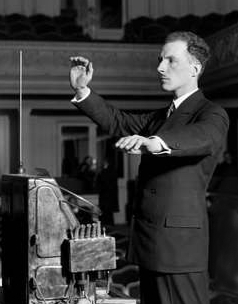
The theremin operates on the principle of heterodyning, a radio frequency technique. It consists of two antennas: one vertical rod controlling pitch and one horizontal loop controlling volume. The musician moves their hands in the air around these antennas without physical contact. As a hand approaches the pitch antenna, it alters the capacitance of an electrical circuit, changing the frequency of an oscillator. This change in frequency is mixed with a second, fixed oscillator, producing an audible tone whose pitch varies with the hand's proximity. Similarly, the hand's position relative to the volume loop affects another circuit, controlling the amplitude or loudness of the sound. The result is an eerie, voice-like timbre that can be manipulated with remarkable expressiveness, a testament to Theremin's understanding of electromagnetic fields and acoustics.
📊 Key Facts & Numbers
Leon Theremin's inventions and life are marked by significant numbers. His espionage device, "The Thing", also known as the Great Seal bug, was discovered by American counterintelligence, demonstrating its remarkable longevity and effectiveness. Theremin himself lived to be 97 years old. He held at least 150 patents throughout his career, spanning a wide array of technological innovations beyond musical instruments.
👥 Key People & Organizations
Beyond Leon Theremin himself, several key figures and organizations shaped his journey. Luigi Russolo, an earlier pioneer of electronic music with his Intonarumori, predated Theremin's work and is often cited as a conceptual precursor. In the United States, RCA was instrumental in the initial mass production of the theremin, though their commercial venture was short-lived. During his forced work in the Soviet Union, Theremin was associated with the NKVD (later KGB), a Soviet security agency, where he developed surveillance technologies. His daughter, Natasha Theremin, later became a prominent advocate for his legacy and a performer of his instrument. Contemporary thereminists like Clarice Assad and Pamelia Stickney continue to push the boundaries of the instrument.
🌍 Cultural Impact & Influence
The cultural impact of Leon Theremin's invention is profound and far-reaching. The theremin's unique, otherworldly sound quickly found its way into early science fiction films and horror soundtracks, becoming synonymous with the uncanny and the futuristic. Composers like Edgard Varèse experimented with the instrument, and its distinctive timbre has been featured in countless film scores, including those for "The Day the Earth Stood Still" (1951) and "Spellbound" (1945), earning Miklós Rózsa an Academy Award for the latter. Beyond soundtracks, the theremin has inspired generations of musicians across genres, from classical and jazz to rock and electronic music, influencing the development of electronic music synthesis and performance practices.
⚡ Current State & Latest Developments
As of 2024, the theremin continues to be a niche but vibrant instrument. While not as mainstream as synthesizers or electric guitars, dedicated communities of thereminists and enthusiasts thrive globally. Manufacturers like Moog Music (founded by Robert Moog, a theremin prodigy himself) continue to produce high-quality theremins, making the instrument accessible to new generations. Theremin festivals and workshops are held regularly, fostering a sense of community and encouraging innovation. Research into Theremin's other inventions, particularly his work on early television, also continues, with historians and engineers re-examining his contributions to broadcast technology.
🤔 Controversies & Debates
The life and work of Leon Theremin are not without controversy. His forced return to the Soviet Union and subsequent work on espionage devices under duress raise complex questions about scientific responsibility and political coercion. While he was awarded the Stalin Prize in 1947 for his contributions to Soviet technology, the circumstances of his later Soviet career remain a subject of debate among historians. Furthermore, the commercial viability of the theremin itself was a point of contention; despite its initial production by RCA, its difficulty to master and unique sound limited its widespread adoption, leading to debates about its potential versus its practical application in popular music.
🔮 Future Outlook & Predictions
The future of Leon Theremin's legacy appears secure, particularly concerning his namesake instrument. As technology advances, we can anticipate further integration of theremin-like interfaces into digital music production and interactive installations. Innovations in sensor technology and digital signal processing could lead to new variations of the theremin, offering greater control and sonic possibilities. Theremin's contributions to early television may also see renewed interest as historians and engineers explore the foundational technologies of modern broadcasting. The ongoing fascination with his life story, a blend of artistic genius, scientific innovation, and Cold War intrigue, ensures his continued relevance in popular culture and scientific discourse.
💡 Practical Applications
The practical applications of Leon Theremin's inventions are diverse. The theremin itself, despite its learning curve, is used in musical performance, film scoring, and experimental sound art. Its core principle of contactless control has also influenced the development of other technologies, including proximity sensors used in industrial automation, security systems, and even early medical devices. His work on early television systems contributed to the foundational research that enabled modern broadcast media. Furthermore, his espionage devices, like "The Thing", represent a significant milestone in the history of electronic surveillance and passive listening devices, demonstrating the potential for sound to be weaponized or used for intelligence gathering.
Key Facts
- Category
- science
- Type
- topic