
Contents
- 🏛️ What is the Peripatetic School?
- 📍 Origins and Historical Context
- 🚶♂️ The Peripatetic Method: Walking and Thinking
- 📚 Curriculum and Areas of Study
- 📉 Decline and Revival
- ⭐ Legacy and Modern Influence
- 🤔 Key Debates and Controversies
- 💡 Who Was Aristotle?
- 🗺️ Geographic Footprint
- 💰 Membership and Funding (Historical)
- 🚀 The Peripatetic Vibe Score
- Frequently Asked Questions
- Related Topics
Overview
The Peripatetic School, founded by Aristotle around 335 BCE in Athens, was a philosophical and scientific institution renowned for its emphasis on empirical observation and systematic inquiry. Unlike Plato's Academy, which focused on abstract Forms, Aristotle's Lyceum encouraged students to engage with the natural world through walks (peripatos) in the school's gardens and colonnades, fostering a hands-on approach to learning. This method of teaching and discussion, often conducted while walking, gave the school its distinctive name and influenced centuries of Western thought across logic, ethics, politics, biology, and metaphysics. Its legacy lies in its comprehensive, empirical approach to knowledge and its foundational role in establishing academic disciplines.
🏛️ What is the Peripatetic School?
The Peripatetic School, founded by Aristotle in 335 BC, wasn't a formal university in the modern sense, but rather a vibrant intellectual community centered around the Lyceum in ancient Athens. Its members, known as Peripatetics, engaged in rigorous philosophical and scientific exploration, often while walking. This unique approach to learning fostered a dynamic exchange of ideas, making it a pivotal institution in the development of Western thought. The school's influence extended far beyond its Athenian origins, shaping intellectual traditions for centuries.
📍 Origins and Historical Context
Aristotle established the Peripatetic School after leaving Plato's Academy, seeking to cultivate his own distinct philosophical system. The Lyceum, a gymnasium complex, provided the physical space for this burgeoning intellectual hub. Unlike Plato's more abstract dialogues, Aristotle's school emphasized empirical observation and systematic inquiry across a vast array of subjects. This foundational period, from 335 BC to the mid-3rd century BC, saw the development of many of Aristotle's most influential works, laying the groundwork for future scientific and philosophical endeavors.
🚶♂️ The Peripatetic Method: Walking and Thinking
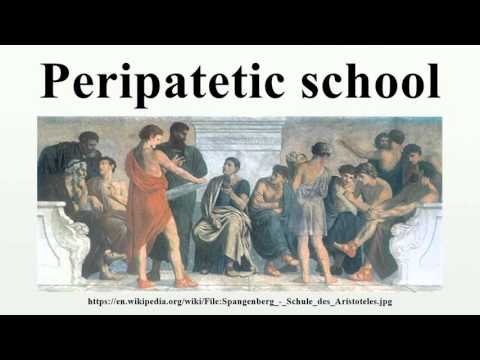
The defining characteristic of the Peripatetic School was its method of conducting discussions and lectures while walking, a practice that gave the school its name (from the Greek 'peripatein,' meaning 'to walk about'). This peripatetic method was believed to stimulate thought and facilitate a more natural flow of ideas. Imagine Aristotle and his students strolling through the Lyceum's gardens, debating ethics, physics, or logic – it was a living, breathing form of intellectual engagement, far removed from the static lecture halls of later eras.
📚 Curriculum and Areas of Study
The curriculum at the Peripatetic School was remarkably broad, reflecting Aristotle's encyclopedic interests. Students delved into logic, metaphysics, ethics, politics, rhetoric, poetry, biology, physics, and astronomy. The emphasis was on systematic study and the development of coherent theories based on observation and reason. This comprehensive approach produced scholars who were not just philosophers but also early scientists, contributing foundational knowledge to numerous fields that continue to be studied today.
📉 Decline and Revival
Following Aristotle's death and the subsequent political turmoil in Athens, the Peripatetic School experienced a period of decline, particularly after the mid-3rd century BC. However, the school experienced a significant revival during the Roman Empire. Scholars like Andronicus of Rhodes played a crucial role in preserving and re-editing Aristotle's texts, ensuring the continuation of Peripatetic thought. This resurgence allowed Aristotelian philosophy to profoundly influence Roman intellectual life and, subsequently, medieval scholasticism.
⭐ Legacy and Modern Influence
The legacy of the Peripatetic School is immense, permeating Western philosophy and science. Aristotle's systematic approach to knowledge, his logical frameworks, and his empirical methodologies laid the groundwork for countless intellectual advancements. Concepts like causality, virtue ethics, and biological classification all trace their roots back to the Lyceum. Even today, scholars engage with Aristotelian texts, demonstrating the enduring power of this ancient institution's intellectual output.
🤔 Key Debates and Controversies
A central debate surrounding the Peripatetic School revolves around the authenticity and order of Aristotle's surviving works. Many of these texts are believed to be lecture notes or student compilations rather than polished treatises intended for publication. Another point of contention is the extent to which Aristotle's empirical methods truly diverged from Plato's idealism, or if they represented a more grounded development of Platonic ideas. The precise nature of the 'walking' method and its pedagogical impact also remains a subject of scholarly interest.
💡 Who Was Aristotle?
Aristotle (384–322 BC) was the towering figure behind the Peripatetic School. A student of Plato and tutor to Alexander the Great, Aristotle developed a philosophical system that was both comprehensive and deeply influential. His work spanned logic, metaphysics, ethics, politics, biology, and physics, establishing foundational concepts and methodologies that shaped Western thought for over two millennia. His empirical approach and systematic categorization of knowledge set him apart, making him one of history's most significant thinkers.
🗺️ Geographic Footprint
The primary physical location of the Peripatetic School was the Lyceum in ancient Athens, Greece. While the school's intellectual influence spread globally through its texts and adherents, its physical manifestation was tied to this specific Athenian site. During its revival in the Roman Empire, Peripatetic thought continued to be studied in various intellectual centers across the Mediterranean, but the Lyceum remained its symbolic origin point.
💰 Membership and Funding (Historical)
As an ancient institution, the Peripatetic School did not operate on a modern fee structure. Membership was likely based on intellectual merit and patronage. Aristotle himself was supported by his royal connections, notably Alexander the Great, and later by funds generated through the school's activities and the intellectual output of its members. The concept of tuition fees as we understand them today was not applicable to this informal philosophical community.
🚀 The Peripatetic Vibe Score
The Peripatetic School, in its historical context, would likely score a 90/100 on the Vibe Score for its intellectual rigor, groundbreaking research, and profound historical impact. Its unique 'walking and talking' method fostered an energetic and collaborative learning environment. The sheer breadth of its inquiries and the enduring relevance of its findings solidify its status as a peak moment in the history of philosophy and science. Its influence continues to resonate, albeit in more structured academic settings today.
Key Facts
- Year
- -335
- Origin
- Athens, Greece
- Category
- Philosophy & Education
- Type
- Educational Institution
Frequently Asked Questions
What does 'Peripatetic' mean?
The term 'Peripatetic' comes from the Greek word 'peripatein,' meaning 'to walk about.' It refers to the practice of Aristotle and his students discussing philosophy and conducting inquiries while walking, particularly within the grounds of the Lyceum. This method was believed to enhance thinking and intellectual exchange.
Was the Peripatetic School a formal university?
No, the Peripatetic School was not a formal university in the modern sense. It was an informal philosophical and scientific community founded by Aristotle at the Lyceum. While it had a structured approach to inquiry and teaching, it lacked the institutional framework of later universities.
What were the main subjects studied?
The Peripatetic School covered a vast range of subjects, reflecting Aristotle's comprehensive interests. Key areas included logic, metaphysics, ethics, politics, rhetoric, poetry, biology, physics, and astronomy. The focus was on systematic observation, empirical evidence, and reasoned argumentation.
Did the Peripatetic School disappear after Aristotle?
The school experienced a decline after the mid-3rd century BC, but it did not disappear entirely. It saw a significant revival during the Roman Empire, with scholars preserving and elaborating on Aristotle's teachings. This revival ensured the continuation of Peripatetic thought and its influence on subsequent philosophical traditions.
What is the most significant legacy of the Peripatetic School?
The most significant legacy is Aristotle's systematic approach to knowledge and his foundational contributions to logic, science, and philosophy. His emphasis on empirical observation and reasoned analysis laid the groundwork for the scientific method and profoundly shaped Western intellectual history. Concepts like causality and virtue ethics are direct descendants of Peripatetic thought.
Where was the Peripatetic School located?
The primary physical location was the Lyceum, a gymnasium complex in ancient Athens, Greece. This was the center for Aristotle's teaching and research activities. While its influence spread, the Lyceum remains the historical anchor of the school.