
Contents
Overview
The formalization of drug development as a structured process is a relatively recent phenomenon, largely emerging in the 20th century. Early medicinal practices relied on empirical observation and traditional remedies, with little understanding of underlying biological mechanisms. The scientific revolution and advancements in chemistry and biology laid the groundwork for a more systematic approach. Key milestones include the isolation of active compounds like morphine from opium in the early 1800s. The Thalidomide tragedy, which led to severe birth defects, was a pivotal moment, spurring the creation of stricter regulatory frameworks like the FDA's Kefauver-Harris Amendment, mandating proof of efficacy and safety before marketing. This era marked the transition from serendipitous discovery to a more rigorous, regulated, and data-driven development paradigm, heavily influenced by institutions like the NIH and major pharmaceutical corporations such as Pfizer and Merck.
⚙️ How It Works
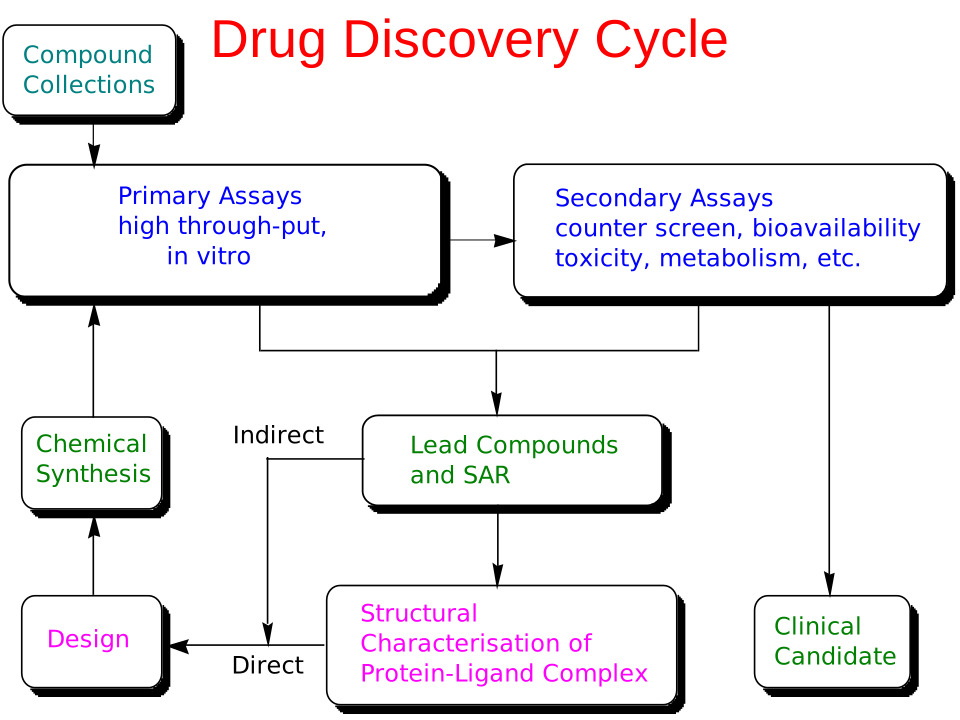
Drug development is a sequential, multi-phase process. It begins with drug discovery, where researchers identify and validate biological targets and discover lead compounds, often through high-throughput screening of chemical libraries or rational drug design. These lead compounds then undergo preclinical research, involving in vitro (cell-based) and in vivo (animal) studies to assess pharmacology, toxicology, and pharmacokinetics. If preclinical data suggest a favorable risk-benefit profile, an Investigational New Drug (IND) application is filed with regulatory authorities, such as the FDA in the United States or the EMA in Europe. This permits the initiation of clinical trials in humans, progressing through Phase I (safety in healthy volunteers), Phase II (efficacy and dose-ranging in patients), and Phase III (large-scale confirmation of efficacy and safety in diverse patient populations). Successful completion of Phase III trials leads to a New Drug Application (NDA) or Marketing Authorization Application (MAA) submission for regulatory review and potential market approval. Post-market surveillance, also known as Phase IV, continues to monitor long-term safety and effectiveness.
📊 Key Facts & Numbers
The financial stakes in drug development are astronomical. The failure rate is exceptionally high. The entire process from discovery to market approval can take an average of 10 to 15 years. The global pharmaceutical market is valued at over $1.4 trillion annually, with R&D spending by major companies often exceeding $10 billion per year.
👥 Key People & Organizations
Numerous individuals and organizations are central to pharmaceutical drug development. Pioneers in early pharmacology include figures like Paul Ehrlich. Modern drug development is driven by large pharmaceutical corporations such as Johnson & Johnson, Roche, and Novartis, alongside numerous smaller biotechnology firms. Regulatory bodies like the FDA and the WHO play critical oversight roles. Academic institutions, including Harvard University and the University of Oxford, are crucial for basic research and talent development. Organizations like the ClinicalTrials.gov registry provide transparency into ongoing human studies, while industry groups like PhRMA advocate for the sector.
🌍 Cultural Impact & Influence
The impact of pharmaceutical drug development on global health and society is profound. It has led to the eradication or control of numerous infectious diseases, such as polio and smallpox, through vaccines like Salk's polio vaccine. Advances in treatments for chronic conditions like cardiovascular disease, diabetes, and cancer have dramatically increased life expectancy and quality of life for millions. The development of antibiotics like penicillin revolutionized the treatment of bacterial infections, saving countless lives. Conversely, the high cost of new drugs, particularly for conditions like rare diseases or advanced cancers, raises significant ethical and access concerns, fueling debates about healthcare affordability and the balance between innovation and patient access. The success of drug development is often celebrated in popular culture, with films and books sometimes dramatizing the race to find cures, as seen in narratives surrounding the development of HIV/AIDS treatments.
⚡ Current State & Latest Developments
The current landscape of drug development is characterized by rapid technological advancements and evolving research paradigms. Artificial intelligence and machine learning are increasingly being integrated into drug discovery and clinical trial design, aiming to accelerate timelines and improve success rates. Genomics and personalized medicine are enabling the development of targeted therapies tailored to individual patient profiles, particularly in oncology. The COVID-19 pandemic highlighted the potential for rapid response to emerging health threats. Furthermore, there's a growing emphasis on novel modalities beyond small molecules and traditional biologics, including gene therapies, cell therapies, and CRISPR-based therapeutics. Regulatory agencies are also adapting, exploring expedited review pathways for promising new treatments.
🤔 Controversies & Debates
Drug development is rife with controversy and debate. The most persistent issue is the exorbitant cost of new medications and the perceived disconnect between R&D expenses and drug pricing. Critics argue that pharmaceutical companies prioritize profitable lifestyle drugs or treatments for affluent markets over neglected diseases affecting poorer populations. The lengthy and complex clinical trial process, while essential for safety, is also debated for its efficiency and ethical considerations, particularly regarding patient recruitment and placebo use. Concerns about data integrity, transparency in reporting trial results, and the influence of industry funding on research outcomes are ongoing. The patent system, designed to incentivize innovation, is also a point of contention, with debates over patent extensions and the accessibility of generic alternatives.
🔮 Future Outlook & Predictions
The future of drug development is poised for significant transformation, driven by technological innovation and a deeper understanding of human biology. Expect further integration of AI and big data to predict drug efficacy and toxicity, potentially reducing failure rates in preclinical and clinical stages. The rise of precision medicine will continue, with therapies increasingly tailored to genetic profiles and disease subtypes. Synthetic biology and advanced manufacturing techniques may enable the production of complex therapeutics more efficiently. Regulatory frameworks will likely continue to evolve, seeking to balance speed and safety, potentially through more adaptive trial designs and real-world evidence integration. The focus may also shift towards pr
Key Facts
- Category
- science
- Type
- topic