
Contents
Overview
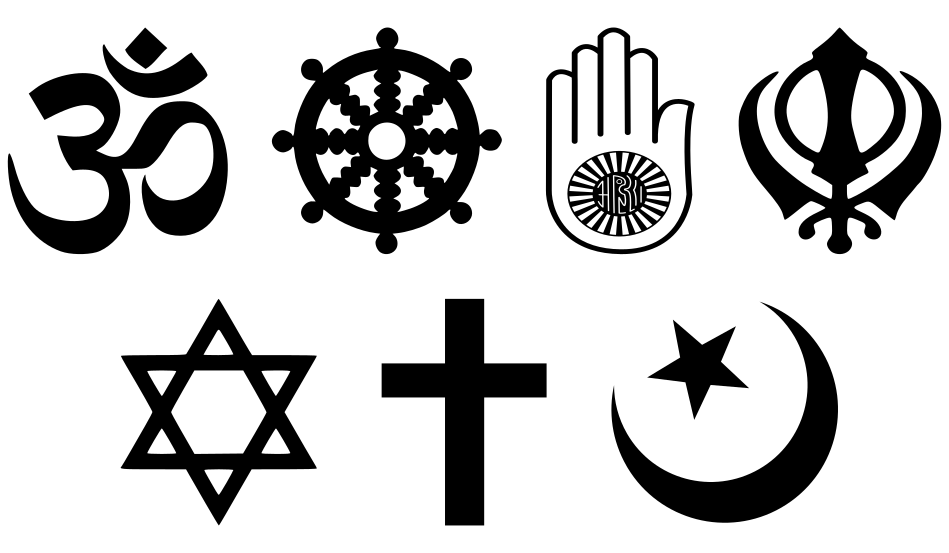
The origins of religious traditions are as old as humanity itself. Early forms likely emerged from attempts to explain natural phenomena, confront mortality, and foster social cohesion within hunter-gatherer societies. The development of agriculture led to more complex societies and, consequently, more formalized religious structures, including pantheons of gods associated with fertility and the seasons. Major milestones include a period of profound philosophical and religious innovation across Eurasia, giving rise to Buddhism, Confucianism, Taoism, Zoroastrianism, and the foundational ideas of Judaism and early Greek philosophy. The subsequent spread of Christianity and Islam, facilitated by trade routes like the Silk Road and imperial expansion, further diversified and globalized religious landscapes, leading to the major world religions that dominate today.
⚙️ How It Works
At their core, religious traditions function by providing a coherent worldview that addresses existential questions: why are we here? What is the nature of reality? How should we live? They achieve this through a combination of shared narratives (myths, scriptures), prescribed practices (prayer, meditation, sacrifice, pilgrimage), ethical codes, and communal rituals that reinforce group identity and belonging. Many traditions posit a relationship with the divine or supernatural, whether through monotheistic deities like God in Judaism and Christianity, polytheistic systems like ancient Greek religion, or immanent spiritual forces found in Buddhism and Taoism. The transmission of these traditions relies on sacred texts (e.g., the Torah, Bible, Quran, Vedas), oral traditions, and the role of religious leaders (priests, imams, rabbis, monks, shamans) who interpret doctrine and guide adherents. The emotional and psychological dimensions are crucial, offering comfort, purpose, and a sense of connection to something larger than oneself.
📊 Key Facts & Numbers
Globally, Indigenous and folk religions, though often undercounted, represent hundreds of millions more. The economic impact is staggering, with religious institutions controlling vast amounts of wealth and property worldwide. Despite these numbers, the proportion of religiously unaffiliated individuals, including atheists and agnostics, has been steadily growing, particularly in Western Europe and North America.
👥 Key People & Organizations
The landscape of religious traditions is shaped by countless individuals and organizations. Key figures include Jesus Christ, whose teachings formed the basis of Christianity; Prophet Muhammad, the founder of Islam; Siddhartha Gautama (the Buddha), whose enlightenment led to Buddhism; Moses, considered a central prophet in Judaism; and Guru Nanak, the founder of Sikhism. Major organizational bodies like the Catholic Church, the World Council of Churches, Al-Azhar University in Cairo (a leading center for Sunni Islamic learning), and the Ramakrishna Mission (a Hindu monastic organization) play significant roles in interpreting doctrine and guiding adherents. Numerous academic institutions, such as Harvard Divinity School and Oxford University's Faculty of Theology and Religion, also contribute through scholarly research and education, often engaging with figures like Karen Armstrong and Ninian Smart who have significantly influenced the academic study of religion.
🌍 Cultural Impact & Influence
Religious traditions have profoundly shaped human civilization, influencing art, architecture, music, literature, law, and social customs for millennia. The Great Mosque of Cordoba and the Angkor Wat temple complex stand as testaments to the architectural prowess inspired by religious devotion. Sacred texts like the Epic of Gilgamesh and the Bhagavad Gita have inspired countless literary works, while religious music, from Gregorian chants to Sufi Qawwali, continues to resonate. Ethical frameworks derived from religious teachings have formed the basis of legal systems and moral codes in societies worldwide, impacting concepts of justice, charity, and human rights. The influence extends to everyday life through holidays, dietary laws (e.g., halal and kosher practices), and rites of passage such as baptisms, bar mitzvahs, and weddings, all of which reinforce cultural identity and communal bonds. The Vatican City serves as a prime example of a state deeply intertwined with a religious institution.
⚡ Current State & Latest Developments
In the early 21st century, religious traditions are navigating a complex global environment marked by both resurgence and secularization. While some regions, particularly in the Global South, are experiencing significant religious growth (e.g., Pentecostalism in Latin America and Africa), others, especially in Europe, are seeing a decline in traditional religious affiliation. The digital age has created new avenues for religious expression and community building, with online sermons, virtual congregations, and social media activism becoming increasingly common, exemplified by the use of platforms like YouTube by religious leaders. Simultaneously, many traditions are grappling with internal challenges, including debates over social issues like LGBTQ+ rights, the role of women in leadership, and responses to scientific advancements. The rise of 'spiritual but not religious' identities also presents a challenge to established religious institutions, indicating a shift in how individuals seek meaning and connection outside traditional frameworks. The World Day of Prayer remains an annual event fostering interfaith dialogue.
🤔 Controversies & Debates
Religious traditions are frequently at the center of intense controversies and debates. One of the most persistent is the tension between religious doctrine and scientific understanding, particularly concerning evolution, cosmology, and bioethics, leading to debates like those surrounding intelligent design. The role of religion in public life and governance is another major point of contention, with ongoing discussions about the separation of church and state, religious freedom, and the influence of religious lobbying groups on policy in countries like the United States. Interfaith relations are often fraught with historical grievances and theological differences, though interfaith dialogue initiatives, such as those promoted by the United Nations, aim to foster understanding and cooperation. Furthermore, within many traditions, there are significant internal debates regarding scriptural interpretation, social justice issues, and the adaptation of ancient practices to modern contexts, such as the ongoing discussions within Islam about modernity and tradition.
🔮 Future Outlook & Predictions
The future of religious traditions is likely to be characterized by continued adaptation and diversification. Some scholars predict a further rise in secularism in historically religious societies, while others foresee a global resurgence of religious fervor, particularly in developing nations. The influence of technology will undoubtedly grow, with virtual reality potentially offering immersive religious experiences and AI playing a role in theological discourse or even the creation of new forms of digital spirituality. Interfaith cooperation is expected to become more critical as global challenges like climate change and p
Key Facts
- Category
- culture
- Type
- topic