
Contents
Overview
SHA-256, a member of the SHA-2 family of cryptographic hash functions, stands as a cornerstone of modern digital security. Designed by the U.S. National Security Agency (NSA) and published in 2002, it transforms any input data into a fixed-size 256-bit (32-byte) hash value. This one-way process is deterministic, meaning the same input always produces the same output, yet it's computationally infeasible to reverse engineer the input from the hash. Its widespread adoption is evident in its critical role in securing Bitcoin transactions, verifying software integrity, and enabling secure TLS/SSL connections. Despite its robust design, ongoing research into quantum computing and cryptanalysis continues to shape its future relevance and the development of its successors.
🎵 Origins & History
The SHA-2 family, including SHA-256, emerged from a need for stronger cryptographic primitives following perceived weaknesses in its predecessor, SHA-1. Developed by the National Security Agency (NSA), the SHA-2 algorithms were first published by the National Institute of Standards and Technology (NIST) in 2001 as part of the FIPS 180-2 standard. SHA-256, specifically, was designed to produce a 256-bit output, offering a significantly larger security margin than SHA-1's 160-bit output. Its official standardization and widespread adoption began in the early 2000s, quickly becoming a preferred choice for applications demanding high levels of data integrity and security, laying the groundwork for its future dominance in various digital domains.
⚙️ How It Works
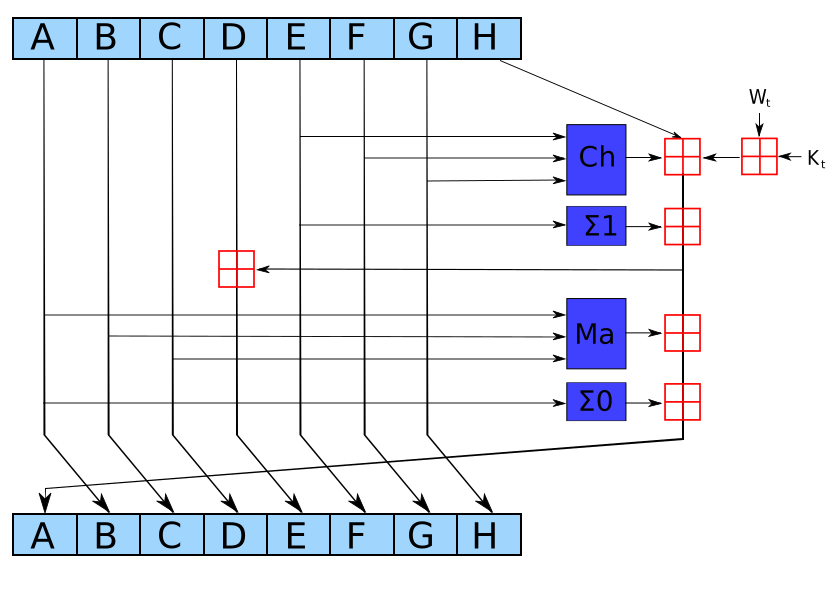
SHA-256 operates on input data of arbitrary length, processing it in fixed-size blocks of 512 bits. The algorithm employs a series of logical operations, including bitwise operations (AND, OR, XOR, NOT), modular addition, and bitwise rotations and shifts, applied across 64 rounds. Each round uses a unique constant and a message schedule derived from the input block. The process begins with an initial hash value, a set of predefined constants, and iteratively updates these values based on the input data. The final output is a 256-bit hash value, a unique fingerprint of the original data, making even a single bit change in the input result in a drastically different hash.
📊 Key Facts & Numbers
SHA-256 generates a fixed-size output of 256 bits, equivalent to 32 bytes or 64 hexadecimal characters. The computational complexity for finding a collision (two different inputs producing the same hash) is approximately 2^128 operations, while brute-forcing a specific hash is around 2^256 operations. As of 2024, SHA-256 is used in over 90% of all SSL certificates issued globally. The Bitcoin network alone processes millions of transactions daily, each secured by SHA-256 hashing, demonstrating its immense scale and critical function in securing trillions of dollars in digital assets.
👥 Key People & Organizations
Key figures and organizations behind SHA-256 include the National Security Agency (NSA), which designed the algorithm, and the National Institute of Standards and Technology (NIST), which standardized it under FIPS 180-2. While specific individual designers are not publicly disclosed by the NSA, cryptographers like Ron Rivest, Adi Shamir, and Leonard Adleman (the 'RSA' in RSA) have been instrumental in the broader field of cryptographic hash functions and have commented on the evolution of SHA standards. Major technology companies like Google, Microsoft, and Apple integrate SHA-256 into their operating systems and security protocols, underscoring its industry-wide importance.
🌍 Cultural Impact & Influence
SHA-256's influence is profound, permeating the digital infrastructure that underpins global communication and commerce. It is the backbone of Bitcoin and numerous other cryptocurrencies, ensuring the integrity and immutability of their ledgers. Beyond finance, it's crucial for digital signatures, verifying the authenticity of software downloads from companies like Microsoft and Apple, and securing web traffic via TLS/SSL certificates issued by entities like Let's Encrypt. Its ubiquity has made it a de facto standard for data integrity checks across countless applications, shaping user trust in digital interactions.
⚡ Current State & Latest Developments
As of 2024, SHA-256 remains highly secure and widely deployed. However, the ongoing advancements in computing power, particularly in quantum computing, present a theoretical future threat. While current quantum algorithms do not pose an immediate practical risk to SHA-256's collision resistance, the development of post-quantum cryptography is actively underway. NIST has been leading efforts to standardize new quantum-resistant algorithms, with SHA-3 and other newer hash functions also gaining traction as potential replacements or complements in the long term.
🤔 Controversies & Debates
The primary debate surrounding SHA-256 centers on its long-term security against future computational advancements, especially quantum computing. While considered secure against classical computers, theoretical quantum algorithms like Grover's algorithm could reduce the effective security against brute-force attacks. Another point of discussion is the NSA's role in its design; some in the cryptographic community express lingering distrust due to past revelations of potential backdoors in other cryptographic standards. However, extensive public analysis by cryptographers worldwide has not revealed any inherent flaws in SHA-256's design that would compromise its integrity for current applications.
🔮 Future Outlook & Predictions
The future of SHA-256 is likely one of continued relevance, albeit with increasing integration of post-quantum cryptographic alternatives. While it will remain a workhorse for many applications where quantum threats are not yet a primary concern, organizations like NIST are actively promoting migration to quantum-resistant algorithms for critical infrastructure. It's plausible that SHA-256 will coexist with newer standards for years to come, serving as a robust baseline for many existing systems while newer, more resilient algorithms handle the most sensitive future applications.
💡 Practical Applications
SHA-256's practical applications are vast and critical. It's fundamental to Bitcoin's proof-of-work consensus mechanism, securing every block and transaction. It's used to generate digital signatures for verifying document authenticity and software integrity, preventing tampering. Web servers use it extensively for TLS/SSL certificates to encrypt internet traffic, ensuring secure communication between browsers and websites. Many file-sharing protocols and backup systems employ SHA-256 to verify that downloaded or restored files match the original, ensuring data integrity. It's also a key component in password hashing schemes, though often combined with salting techniques to enhance security.
Key Facts
- Category
- technology
- Type
- technology