
Contents
Overview
The Warring States period didn't erupt overnight; it was the violent crescendo of a long decline in central authority. Preceded by the Spring and Autumn period, where Zhou dynasty kings were increasingly nominal rulers, the stage was set for powerful regional states to assert themselves. While some scholars argue for earlier dates, citing the partition of the Jin state into Han, Zhao, and Wei as a more definitive marker, the exact start date of the Warring States period remains debated among historians. This fragmentation intensified the competition, transforming diplomatic maneuvering and limited conflicts into a relentless struggle for survival and dominance. The philosophical landscape also shifted dramatically, with thinkers like Confucius laying groundwork that would be further developed by figures like Mencius and Han Fei Zi in their attempts to understand and rectify the societal breakdown.
⚙️ How It Works
The 'how' of the Warring States period is a brutal testament to escalating military and administrative sophistication. States developed professional armies, moving away from feudal levies, and introduced mass conscription. Innovations like the crossbow, cavalry tactics, and siege warfare became commonplace, dramatically increasing the scale and lethality of battles. Simultaneously, states implemented complex bureaucratic systems to manage resources, collect taxes, and administer justice, enabling them to sustain prolonged campaigns. The concept of 'heng zong lian heng' (vertical and horizontal alliances) became a crucial diplomatic strategy, as states attempted to forge alliances against stronger rivals or isolate weaker ones. This period saw the rise of the 'shi' (士), a class of scholar-officials and military strategists who advised rulers and implemented reforms, often shifting allegiances between states in pursuit of their patrons' ambitions.
📊 Key Facts & Numbers
The sheer scale of conflict and transformation during the Warring States period is staggering. The state of Qin, in particular, mobilized vast resources. The economic output of these states grew significantly, with advancements in agriculture like iron plows and irrigation systems boosting food production. The construction of defensive walls, precursors to the Great Wall of China, spanned thousands of miles.
👥 Key People & Organizations
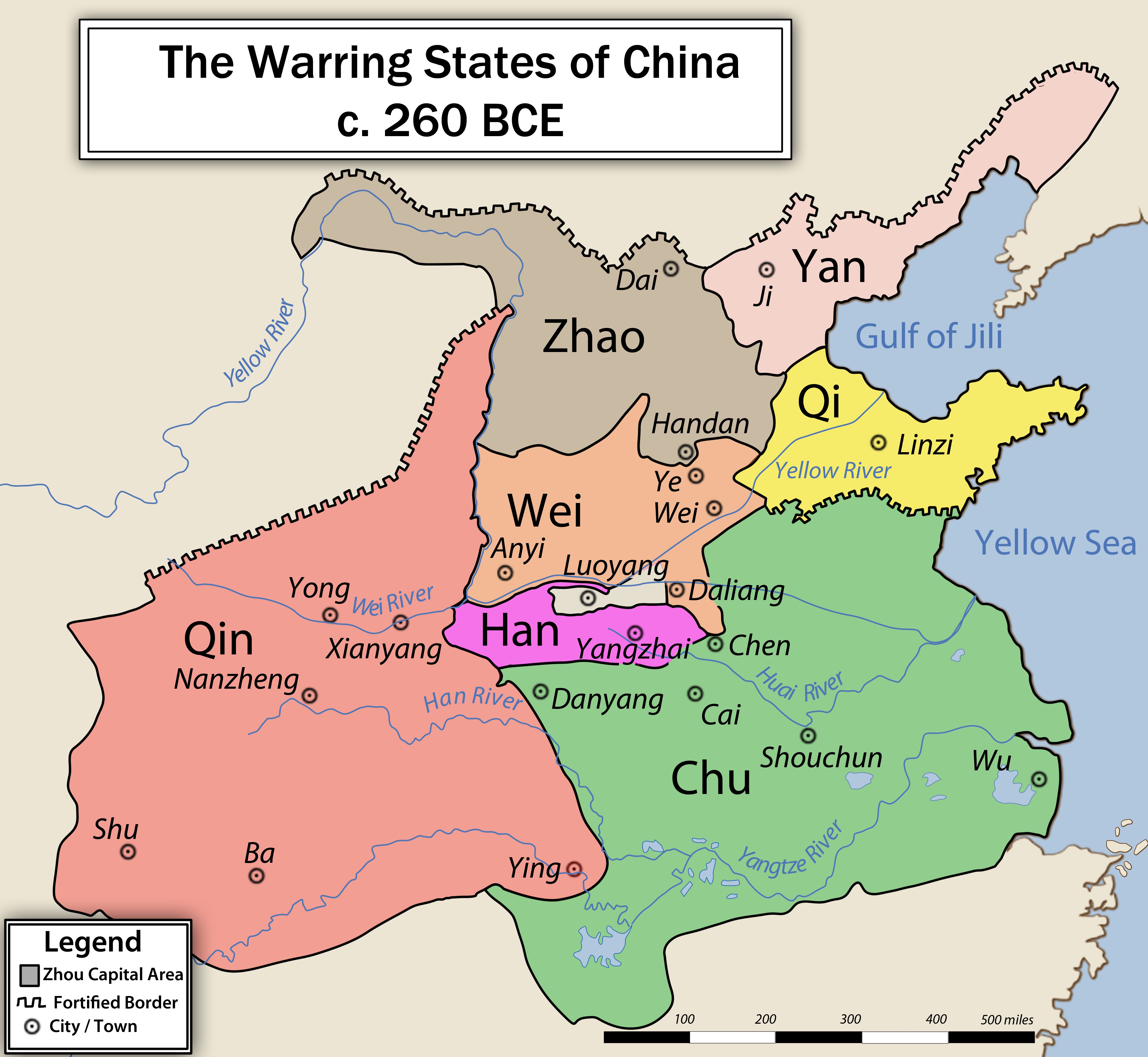
The Warring States period was defined by its ambitious rulers and influential thinkers. Key figures include Qin Shi Huang, the King of Qin who ultimately unified China, and his chief minister Li Si, who championed Legalist reforms. Other significant rulers included King Wuling of Zhao, who famously adopted nomadic cavalry tactics, and King Huiwen of Qin, who expanded Qin's territory significantly. Philosophically, Mencius championed Confucian ideals of benevolent governance, while Han Fei Zi articulated the principles of Legalism, advocating for strict laws and harsh punishments. The states themselves—Qin, Chu, Qi, Yan, Han, Zhao, and Wei—acted as major political entities, each with its own ruling house and administrative apparatus, constantly maneuvering against each other.
🌍 Cultural Impact & Influence
The Warring States period left an indelible mark on Chinese civilization and beyond. The philosophical debates of the 'Hundred Schools of Thought' (诸子百家) provided foundational concepts for East Asian thought, influencing governance, ethics, and social structures for millennia. Confucianism, with its emphasis on hierarchy, filial piety, and education, became a dominant ideology, shaping the imperial examination system and social norms. Taoism offered a counterpoint, focusing on naturalness and detachment. The Legalist principles of Qin provided the administrative blueprint for centralized imperial rule that would persist for over two thousand years. The very concept of a unified China, rather than a collection of warring states, was forged in this crucible, influencing national identity and geopolitical aspirations across East Asia, including in Korea, Japan, and Vietnam.
⚡ Current State & Latest Developments
While the Warring States period itself is a historical epoch, its legacy continues to resonate in contemporary geopolitical strategies and philosophical discourse. Modern China's emphasis on national unity and territorial integrity can be seen as a direct descendant of the Qin unification. The philosophical schools born during this era—Confucianism, Taoism, and Legalism—remain subjects of intense academic study and cultural relevance, with their ideas continually reinterpreted in light of modern challenges. Furthermore, the strategic principles and military innovations developed during this time are still analyzed in military academies worldwide, offering timeless lessons on statecraft, logistics, and the psychology of warfare. The ongoing archaeological discoveries, such as the Terracotta Army, continue to reveal new insights into the material culture and military might of the period.
🤔 Controversies & Debates
The Warring States period is rife with controversy, primarily concerning the interpretation of its origins and the nature of its legacy. The exact start date remains debated among historians, with differing views on whether the partition of Jin or earlier events better signify the transition from the Spring and Autumn period. The morality of Legalism, the dominant state ideology of Qin, is another persistent point of contention; while it enabled unification, its emphasis on harsh punishment and absolute state control is ethically problematic for many. Furthermore, the narrative of Qin's inevitable triumph is sometimes challenged by scholars who highlight the agency of other states and the contingent nature of historical outcomes. The extent to which the philosophical 'Hundred Schools of Thought' truly represented widespread popular beliefs versus elite intellectual currents is also a subject of ongoing academic debate.
🔮 Future Outlook & Predictions
The future outlook for understanding the Warring States period is bright, driven by technological advancements and interdisciplinary research. Ongoing archaeological excavations, particularly in China, are continuously unearthing new textual evidence and material artifacts that challenge and refine existing historical narratives. Advances in archaeological dating techniques and genetic analysis of human remains may offer deeper insights into the demographics and social structures of the time. Furthermore, the application of computational linguistics to ancient texts promises to unlock new understandings of the philosophical and political discourse. We can anticipate revised timelines, a more nuanced understanding of inter-state relations, and potentially even the discovery of previously unknown philosophical schools or political treatises that could reshape our comprehension of this foundational era.
💡 Practical Applications
The practical applications of studying the Warring States period are manifold, extending far beyond academic curiosity. Its most significant application lies in understanding the historical roots of Chinese statecraft and governance; the principles of centralized bureaucracy, standardized law, and meritocratic (albeit imperfect) administration pioneered by Qin continue to inform political structures. The philosophical insights from Confucianism and Taoism are applied in modern leadership training, conflict resolution, and personal development. Military historians and strategists analyze the period's innovations in siege warfare, logistics, and psychological operations for contemporary relevance. Furthermore, the artistic and architectural achievements, such as the early forms of
Key Facts
- Category
- history
- Type
- topic