
Contents
- 🎵 Origins & History
- ⚙️ How It Works
- 📊 Key Facts & Numbers
- 👥 Key People & Organizations
- 🌍 Cultural Impact & Influence
- ⚡ Current State & Latest Developments
- 🤔 Controversies & Debates
- 🔮 Future Outlook & Predictions
- 💡 Practical Applications
- 📚 Related Topics & Deeper Reading
- Frequently Asked Questions
- References
- Related Topics
Overview
The scientific inquiry into climate change traces its roots back to the 19th century. In 1824, Joseph Fourier first proposed that Earth's atmosphere could trap heat, a phenomenon he termed the 'greenhouse effect.' Later, in 1859, John Tyndall experimentally demonstrated that certain gases, like water vapor and CO2, absorb infrared radiation, thus confirming Fourier's hypothesis. The first quantitative predictions of warming due to increased CO2 from burning fossil fuels were made by Svante Arrhenius in 1896, who calculated that a doubling of atmospheric CO2 could lead to a significant global temperature rise. Early 20th-century research focused on natural climate variations, but by the mid-1950s, scientists like Charles David Keeling began meticulously measuring atmospheric CO2 levels at Mauna Loa Observatory, revealing a steady, undeniable upward trend that would later be known as the Keeling Curve.
⚙️ How It Works
Climate change science operates by observing and modeling the Earth's complex climate system, which involves interactions between the atmosphere, oceans, land surface, ice, and living organisms. The core mechanism studied is the greenhouse effect, where gases like CO2, methane, and nitrous oxide trap outgoing infrared radiation, warming the planet. Scientists use a combination of direct measurements (e.g., satellite data on temperature, sea level, and ice extent; ground-based weather stations; ocean buoys) and sophisticated climate models to simulate past, present, and future climate scenarios. These models, based on fundamental laws of physics and chemistry, allow researchers to attribute observed changes to specific drivers, such as fossil fuel combustion and deforestation, and to project potential future impacts under different emission pathways.
📊 Key Facts & Numbers
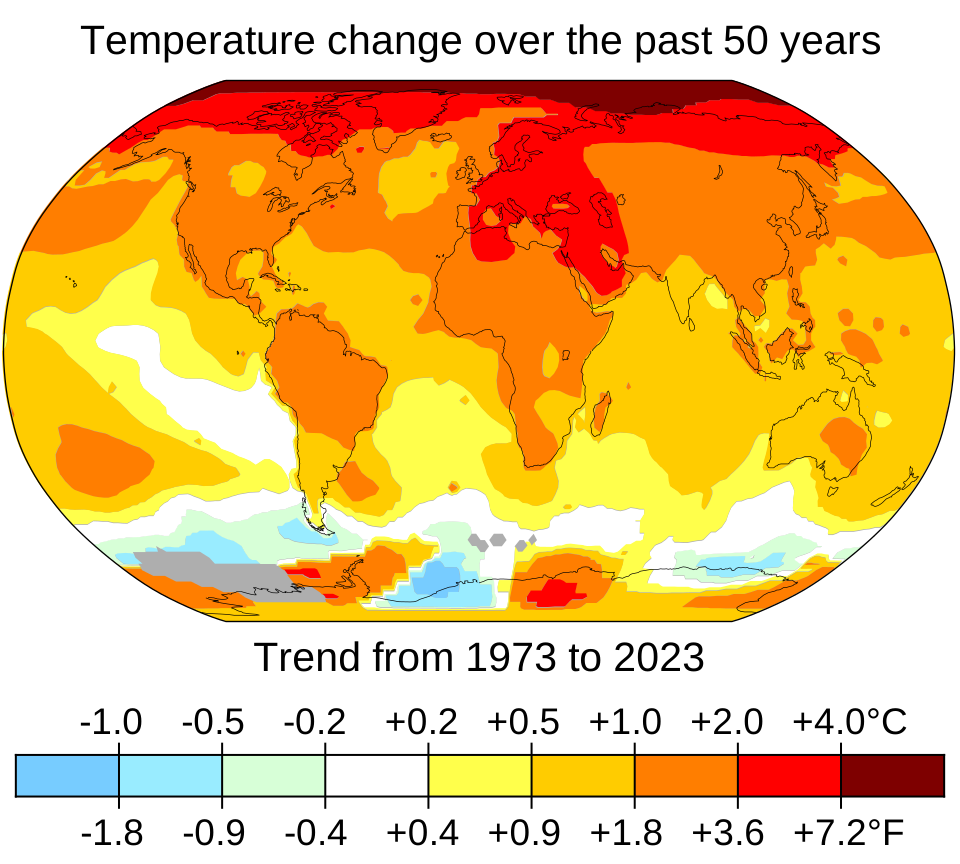
The evidence for human-caused climate change is quantified by numerous metrics. Global average surface temperature has risen by approximately 1.1°C (2°F) since the pre-industrial period (1850-1900), according to the IPCC's Sixth Assessment Report (2021). Atmospheric CO2 concentrations now exceed 420 parts per million (ppm), a level not seen in at least 800,000 years, and are roughly 50% higher than pre-industrial levels. Global sea levels have risen by about 20 cm (8 inches) in the last century, and the rate of rise is accelerating. The Arctic is warming at more than twice the global average rate, leading to significant reductions in sea ice extent. Extreme weather events, such as heatwaves and heavy precipitation, have become more frequent and intense in many regions, with attribution studies linking specific events to climate change.
👥 Key People & Organizations
Key organizations and individuals have shaped the field of climate change science. The IPCC, established in 1988 by the WMO and the UNEP, synthesizes the work of thousands of scientists worldwide into comprehensive assessment reports, providing a critical consensus view. Prominent researchers include Syukuro Manabe and Klaus Hasselmann, who shared the 2021 Nobel Prize in Physics for their work on climate modeling. James Hansen, a former NASA scientist, became a public figure for his early and forceful warnings about global warming in the 1980s. National science academies, such as the U.S. National Academy of Sciences, and international bodies like the WMO play vital roles in coordinating research and disseminating findings. Numerous universities and research institutions globally, including MIT, Stanford University, and the University of Oxford, host leading climate science departments.
🌍 Cultural Impact & Influence
Climate change science has profoundly influenced global discourse, policy, and culture. It has spurred the creation of international agreements like the Paris Agreement (2015), aiming to limit global warming. The scientific findings have fueled a global environmental movement, raising public awareness and driving demand for sustainable practices and renewable energy sources like solar power and wind power. Media coverage, from documentaries like Al Gore's "An Inconvenient Truth" to news reports on extreme weather, has brought the issue to the forefront of public consciousness. The science also underpins the development of new technologies, adaptation strategies for vulnerable communities, and debates about climate justice and the responsibilities of different nations and industries, such as ExxonMobil and Shell.
⚡ Current State & Latest Developments
The current state of climate change science is characterized by increasing precision in modeling, a deeper understanding of regional impacts, and a growing focus on feedback loops and tipping points. Recent research, particularly highlighted in the IPCC's AR6 report (2021-2023), emphasizes that human influence is unequivocal and that many observed changes are unprecedented. There's a heightened focus on climate adaptation strategies, understanding the role of geoengineering technologies, and refining projections for extreme events. The development of higher-resolution climate models and the integration of artificial intelligence are improving the accuracy of forecasts. Furthermore, the science is increasingly engaging with socio-economic factors, exploring the links between climate change and public health, migration, and economic stability, with organizations like the WHO playing a key role.
🤔 Controversies & Debates
Despite a strong scientific consensus, controversies persist, often fueled by political and economic interests rather than scientific uncertainty. Debates sometimes arise regarding the precise timing and magnitude of future impacts, the optimal policy responses, and the attribution of specific extreme weather events solely to human-caused climate change. Historically, there have been organized efforts by some fossil fuel companies and associated think tanks to sow doubt about the scientific consensus, a tactic documented in numerous investigative reports. While the fundamental science is robust, discussions continue about the speed of transition to renewable energy, the feasibility and ethics of geoengineering solutions, and the equitable distribution of the costs and benefits of climate action, particularly concerning developing nations and indigenous communities.
🔮 Future Outlook & Predictions
The future of climate change science points towards more refined predictions and a greater emphasis on actionable solutions. Scientists are working to improve understanding of complex Earth system processes, such as the role of clouds, aerosols, and ocean currents, and to better quantify the risks associated with crossing critical tipping points (e.g., collapse of the Greenland ice sheet). Research will increasingly focus on the effectiveness and potential side effects of various mitigation and adaptation strategies, including carbon capture technologies and nature-based solutions. The integration of climate science with economics, sociology, and political science will be crucial for developing effective, equitable, and implementable policies. Projections suggest that without aggressive emissions reductions, global temperatures could rise by 2-4°C by the end of the century, necessitating significant societal transformation.
💡 Practical Applications
Climate change science has direct practical applications across numerous sectors. It informs urban planning for resilience against heatwaves and flooding, guides agricultural practices to cope with changing weather patterns and water availability, and supports the development of renewable energy infrastructure by identifying optimal locations and predicting resource availability. The insurance industry uses climate models to assess risks and set premiums for climate-related disasters. Public health organizations rely on climate science to predict and prepare for heat-related illnesses, the spread of vector-borne diseases, and food insecurity. Furthermore, it provides the scientific basis for international climate negotiations, national emissions targets, and the development of carbon markets and carbon capture technologies.
Key Facts
- Year
- 1824-present
- Origin
- Global
- Category
- science
- Type
- concept
Frequently Asked Questions
What is the primary driver of current climate change?
The primary driver of current climate change is the increased concentration of greenhouse gases in the Earth's atmosphere, predominantly CO2, methane, and nitrous oxide. These gases are released mainly through human activities, particularly the burning of fossil fuels for energy, deforestation, and industrial processes. These gases trap heat that would otherwise escape into space, leading to a gradual warming of the planet's surface and lower atmosphere, a phenomenon known as the enhanced greenhouse effect. The IPCC has unequivocally stated that human influence has warmed the atmosphere, ocean, and land.
How do scientists know climate change is happening and that humans are causing it?
Scientists rely on multiple lines of evidence. Direct measurements from weather stations and satellites show a clear warming trend, with global average temperatures rising significantly since the pre-industrial era. Observations also reveal rising sea levels, melting glaciers and ice sheets, and changes in precipitation patterns. Crucially, the isotopic signature of atmospheric CO2 clearly indicates that the increase comes from burning fossil fuels, not natural sources. Climate models that incorporate only natural factors fail to replicate observed warming, while those including human-caused greenhouse gas emissions accurately simulate the observed changes, providing strong evidence for attribution.
What are the main impacts of climate change predicted by science?
The impacts are widespread and varied. They include more frequent and intense heatwaves, altered precipitation patterns leading to both droughts and floods, sea-level rise threatening coastal communities, ocean acidification harming marine life, and increased intensity of tropical cyclones. Ecosystems are under stress, leading to biodiversity loss and shifts in species ranges. Human societies face risks to food and water security, increased displacement, and potential exacerbation of conflicts. The IPCC's reports detail these projected impacts across different warming scenarios, emphasizing that risks increase significantly with every additional degree of warming.
What is the difference between climate change and global warming?
Global warming specifically refers to the long-term heating of Earth’s climate system observed since the pre-industrial period (between 1850 and 1900) due to human activities, primarily fossil fuel burning, which increases heat-trapping greenhouse gas levels in Earth’s atmosphere. Climate change, on the other hand, is a broader term that encompasses global warming but also includes the resulting long-term shifts in weather patterns and the wider effects on Earth's climate system. So, while global warming is a key component, climate change refers to the full spectrum of changes, including changes in precipitation, extreme weather events, and sea-level rise, all of which are consequences of the warming trend.
Are there any significant scientific uncertainties remaining about climate change?
While the fundamental science of human-caused warming is robust, uncertainties exist in the precise magnitude and timing of future impacts, particularly at regional levels. For instance, the exact sensitivity of the climate system to greenhouse gas increases, the behavior of clouds, and the potential for abrupt tipping points (like rapid ice sheet melt) are areas of active research. However, these uncertainties do not negate the overwhelming evidence of warming or the need for action; rather, they highlight the potential for even more severe outcomes than currently projected, underscoring the importance of precautionary measures. The IPCC reports meticulously detail these areas of uncertainty.
How can climate change science be used to develop solutions?
Climate change science provides the essential foundation for developing solutions. It identifies the problem (human-caused warming), quantifies its scale, and projects future risks, thereby establishing the urgency and necessity for action. Science informs mitigation strategies by pinpointing the sources of emissions and evaluating the potential of renewable energy technologies, carbon capture, and land-use changes to reduce them. It guides adaptation by predicting future environmental conditions (e.g., sea-level rise, drought frequency) and informing the design of resilient infrastructure, agricultural practices, and disaster preparedness plans. Scientific assessments, like those from the IPCC, are critical for policymakers to set targets and design effective climate policies.
What are the latest advancements in climate change science?
Recent advancements include increasingly sophisticated climate models that can simulate regional climate impacts with greater accuracy, often incorporating AI and machine learning. There's a growing focus on understanding climate tipping points and feedback loops, such as permafrost thaw releasing methane or changes in ocean currents. Attribution science has become more robust, allowing scientists to link specific extreme weather events to climate change with higher confidence. Research is also expanding into the complex interactions between climate change and other global challenges, like biodiversity loss, public health (e.g., through the WHO), and economic stability, as well as exploring the potential and risks of geoengineering approaches.