
Contents
Overview
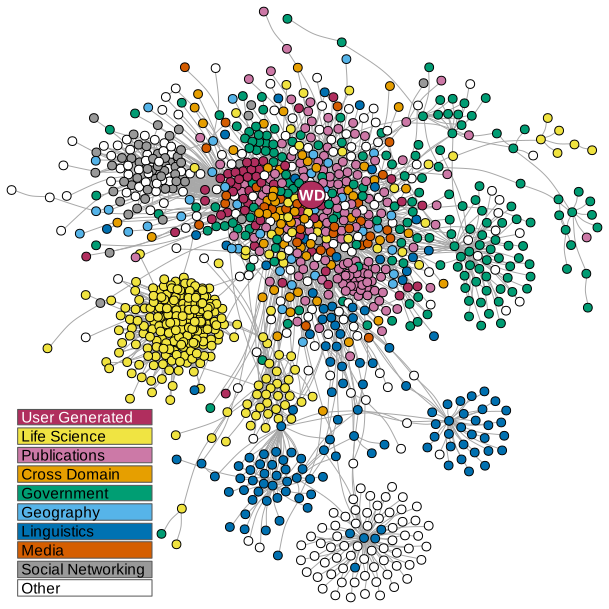
The conceptual roots of Linked Open Data are deeply intertwined with the vision of the Semantic Web, first articulated by Tim Berners-Lee in the early 2000s. Berners-Lee, then director of the W3C, envisioned a web where data, not just documents, could be linked and understood by machines. In a 2006 design note, he formally introduced the term 'linked data' to describe this vision. The subsequent evolution saw the integration of the 'open' aspect, emphasizing free access and reuse, leading to the formalization of LOD principles. Early efforts like the Semantic Web Stack provided the foundational technologies, while initiatives like the W3C LOD Project and the LOD Cloud began to aggregate and showcase available datasets, laying the groundwork for a global data network.
⚙️ How It Works
At its core, LOD operates by publishing data using RDF triples, which consist of a subject, predicate, and object. Each of these components is a URI, allowing them to be dereferenced on the web to find more information or to link to other datasets. Data is typically queried using SPARQL, a query language designed for RDF. The 'open' aspect means this data is published under licenses like Creative Commons or Open Government Licence, permitting widespread reuse and redistribution without significant restrictions, fostering a collaborative data ecosystem.
📊 Key Facts & Numbers
The scale of LOD is staggering, with the LOD Cloud currently hosting over 15,000 datasets, encompassing more than 1.2 trillion RDF triples as of late 2023. These datasets span a vast array of domains, from government and science to culture and economics. For example, the DBpedia project alone extracts structured information from Wikipedia. Government open data initiatives, such as data.gov in the US and data.gov.uk in the UK, contribute millions of datasets. The EU's Europe Data Portal aggregates data from across member states, further expanding the LOD landscape. This interconnectedness allows for complex queries across previously disparate sources, enabling insights that would be impossible with siloed data.
👥 Key People & Organizations
Several key figures and organizations have been pivotal in the development and promotion of LOD. Tim Berners-Lee, as the inventor of the World Wide Web, laid the conceptual groundwork for linked data. Nigel Shadbolt and Paul Groth have been leading advocates and researchers in the field, particularly through their work at the University of Southampton and the Vrije Universiteit Amsterdam, respectively. The W3C's Semantic Web Health Care and Life Sciences Working Group and the Semantic Web Education and Research Community Group have been crucial in developing and standardizing the underlying technologies. Major institutions like Google (through its Schema.org initiative) and organizations such as the Open Knowledge Foundation have also played significant roles in promoting LOD principles and practices.
🌍 Cultural Impact & Influence
LOD has profoundly influenced how information is accessed, integrated, and utilized across numerous sectors. In academia, it facilitates cross-disciplinary research by enabling the linking of datasets from fields as diverse as genomics, climate science, and social sciences. For instance, the Gene Ontology Consortium uses LOD to link biological data, improving research into gene function. In journalism, LOD supports data-driven investigations, allowing reporters to connect disparate pieces of information to uncover trends and stories. The rise of knowledge graphs by companies like Google and Meta is a direct manifestation of LOD principles, powering search results, recommendation engines, and AI assistants. Cultural heritage institutions, such as the British Museum and the Rijksmuseum, are increasingly publishing their collections as LOD, making historical artifacts and artworks discoverable and linkable on a global scale.
⚡ Current State & Latest Developments
The LOD ecosystem is in a constant state of growth and refinement. As of 2024, there's a significant push towards more dynamic and real-time LOD, moving beyond static dumps to continuously updated data streams. The development of GraphQL APIs, while not strictly RDF, is influencing how data is exposed and consumed, sometimes in conjunction with LOD. Efforts are underway to improve the quality and coverage of existing LOD datasets, with a focus on data validation and provenance tracking. New tools and platforms are emerging to simplify the creation, publication, and consumption of LOD, lowering the barrier to entry for developers and data providers. The integration of LOD with AI and machine learning models is also a major trend, enabling more sophisticated data analysis and automated decision-making.
🤔 Controversies & Debates
The primary controversy surrounding LOD revolves around data quality, discoverability, and the sustainability of open data initiatives. While the LOD Cloud boasts millions of datasets, many are outdated, poorly documented, or incomplete, making them difficult to use effectively. The sheer volume of data also presents a discoverability challenge; finding the right dataset for a specific need can be akin to finding a needle in a haystack. Furthermore, the long-term sustainability of many open data projects is uncertain, as they often rely on grant funding or volunteer efforts. Critics also point to the complexity of RDF and SPARQL as barriers to wider adoption, arguing that simpler data formats might be more accessible to a broader audience. The debate over licensing and data ownership also persists, even within the 'open' paradigm.
🔮 Future Outlook & Predictions
The future of LOD is poised for significant expansion and integration. We can anticipate a continued surge in the volume and variety of LOD datasets, driven by increasing government mandates for open data and growing industry adoption of knowledge graphs. Expect to see more sophisticated AI-driven tools for discovering, cleaning, and integrating LOD, making it more accessible to non-experts. The convergence of LOD with other emerging technologies, such as blockchain for data provenance and decentralized web technologies, could lead to new models for data governance and sharing. The vision of the Semantic Web as a global, intelligent database is inching closer to reality, with LOD serving as its foundational infrastructure, enabling a more connected and informed digital world. The next decade will likely see LOD move from a niche technology to a ubiquitous component of the internet's information architecture.
💡 Practical Applications
LOD has a wide range of practical applications across various domains. In scientific research, it enables the integration of heterogeneous datasets for drug discovery, climate modeling, and materials science. For instance, the European Bioinformatics Institute uses LOD to link genomic and proteomic data. In public administration, LOD supports transparency and accountability by making government data accessible for analysis, leading to better policy-making and service delivery. Cultural heritage organizations leverage LOD to create rich, interconnected digital archives of their collections, enhancing public access and research. In the commercial sector, com
Key Facts
- Category
- technology
- Type
- topic